tirsdag 6. februar 2018

DENIERS ATTACKS ON NASA


DENIERS ATTACKS ON NASA

Svertekampanjene/angrepene mot NASA.


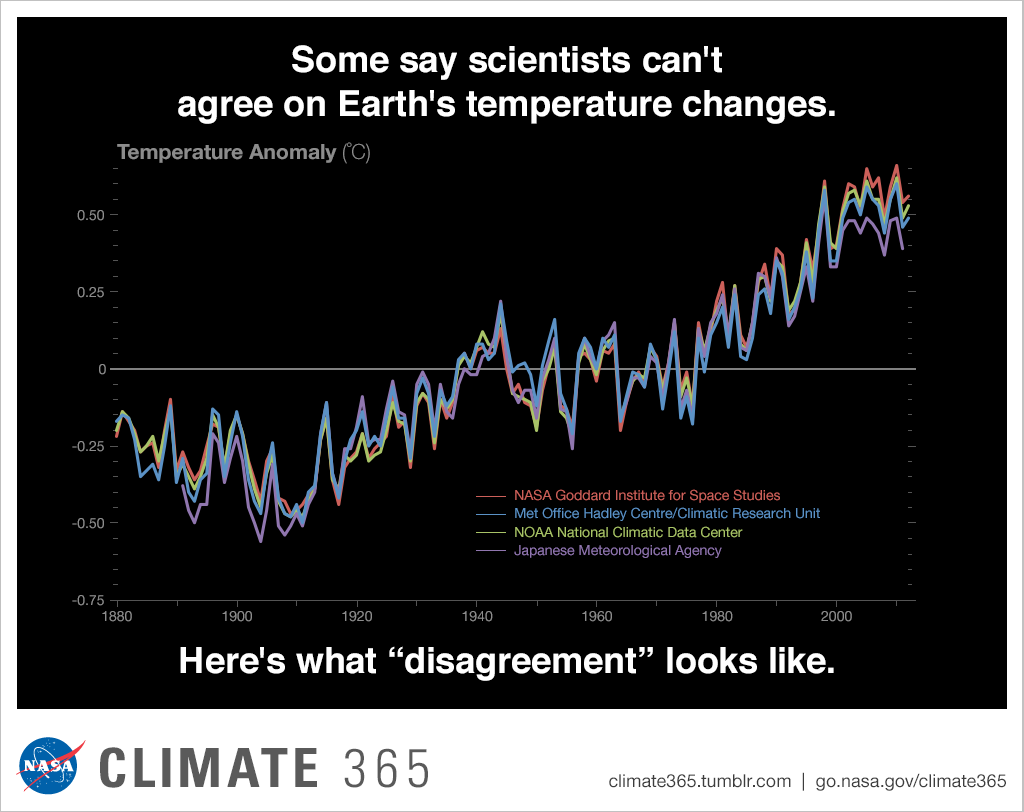
De kyniske svertekampanjene mot NASA sin klimavitenskap foregår både direkte, men og indirekte. At NASA har fikset på grafer har vi fått høre lenge.

Faktsik.no oppklarer:


Bloggeren Goddards hysteriske konspira oppklart:


"We rate the claim Pants on Fire."
 

"It should be no shock that the data shifted following 1999, as illustrated graphically in the above diagram, because NASA published multiple papers in 1999 and 2001 about these changes and why they were made. Links to these papers can be found on the NASA website, which also publicly summarizes the changes in several other places."

https://www.snopes.com/fact-check/global-warming-data-faked/

ENDA EN DEBUNK FINNER DU HER:Her


Even fellow deniers have debunked Goddards silly hoax. And this is too funny:



Anthony Watts, a popular skeptic of most climate change data, posted his objection to Goddard’s claim.


.."while it is true that NOAA does a tremendous amount of adjustment to the surface temperature record, the word “fabrication” implies that numbers are being plucked out of thin air in a nefarious way when it isn’t exactly the case. [...] “Goddard” is wrong is his assertions of fabrication". [...] "I took Goddard to task over this as well in a private email, saying he was very wrong and needed to do better,"

http://reason.com/blog/2014/06/23/did-nasanoaa-dramatically-alter-us-tempe

http://rankexploits.com/musings/2014/how-not-to-calculate-temperature/#comment-130003

https://climatecrocks.com/2014/06/25/fox-news-flash-nasa-fakes-temp-data-obama-born-in-kenya-batboy-found-in-cave/

https://blog.hotwhopper.com/2014/06/noaa-and-temperature-data-it-must-be.html

https://twitter.com/curryja/status/483006570876243968


Flere av angrepene på NASA oppklares her. Se og avsnittet om The Global Warming Swindle (sic)-filmen sist i del 3.
________________________________________________

THE NASA STUDY DENIERS LOVE TO RECYCLE 

A new NASA study found that there has been a net increase in land ice in Antarctica in recent years, despite a decline in some parts of the continent. The study's lead author astutely predicted that climate science deniers would distort the study, even though it does nothing to contradict the scientific consensus on climate change or the fact that sea levels will continue to rise. 
In one study published in Geophysical Research Letters, researchers say East Antarctica is gaining three times less ice than the NASA scientists found — enough to easily tip the balance the other direction. The latest research was led by scientists at the University of Bristol and used data sets similar to those used by the NASA team, but also added in observations from the Grace spacecraft. The NASA satellite can measure minute changes in Earth’s gravitational field to watch Antarctica shed the weight of ice.


During their study period, which included data from 2003 to 2013, Antarctica as a whole added to sea level rise, they found. “In every experiment, mass loss from the west always exceeded gains in the east,” lead author Jonathan Bamber of the University of Bristol said in a media release.
Zwally says the problem is that East Antarctica is so enormous even tiny discrepancies can completely change the answer. “In West Antarctica, you’re looking at bigger changes over a small area,” Zwally says. “And in East Antarctica, you’re looking at smaller changes over a much bigger area.”
Zwally still stands by his 2015 study, but in an interview last week, he said nature has recently changed the equation. His team is crunching numbers from the past two years, looking at ice melting and snowfall rates in Antarctica. And they found something startling. The melt rates in West Antarctica just increased significantly. His calculations now show that the continent is in overall balance. The findings haven’t been peer reviewed yet, but he plans to present them at a science conference later this year. “In our paper we said that might happen in two to three decades,” Zwally says. “Well, this is an unpublished result, but now we’re very close to the zero line.”
Denne lille uenigheten og overskrifter om at Antarktis-ismassen totalt vokser, gir selvsagt klimafornektere vann på møllen. "So much for settled science og global warming" ljomer det i ekkokammerne deres. Så la oss oppklare:
NASA Scientist Warned Deniers Would Distort His Antarctic Ice Study
So, how can Antarctica be gaining ice mass in a warming world where ice sheets are collapsing and the melting is predicted to increase sea levels across the globe? It turns out that the two phenomena — a growing ice sheet and warming-related melting — are not mutually exclusive. Moreover, the NASA study, which was published Oct. 30 in the Journal of Glaciology, does not disprove global warming. 
_________________________________________________________________
Zwally et al 2015 took an unconventional approach to assessing the mass balance of Antarctica. Unlike other studies, before and since, that used satellite altimetry or satellite gravimetric methods, Zwally’s team chose to compare net snowfall accumulation to estimated ice discharge to the ocean in a dataset that ended in 2008. In order to do this type of analysis properly, 3 main things are needed:

1. It is critical to use the most optimal corrections for instrument biases (the ICESat data used need to have the appropriate saturation bias corrections to get real-world answers that are reproducible)

2. The most-accurate densities of snow have to be used

3. The most-optimal values for changes in bedrock elevation (GIA) in response to ice sheet mass changes have to be used

As has been since determined by multiple studies (A, B, C, D, E, F and G, listed following):

1. The ICESat bias corrections used by the Zwally team were appropriate for measuring sea ice, but not for measuring high altitude land-based ice sheets like found in Antarctica (the values returned for Lake Vostok alone were so unphysical that they should have mad the entire study DOA)

2. A value for snowfall density different than that determined by decades of land-based research was used

3. The values used by the Zwally team to correct for GIA were too high by a factor of 2

As such, their results cannot be reproduced using well-established bias corrections, known snow densities and more appropriate values for GIA.

Looking at even more recent studies, per Gardner et al 2018:

"Including modeled rates of snow accumulation and basal melt, the Antarctic ice sheet lost ice at an average rate of 183 ± 94 Gt yr−1 between 2008 and 2015."

Results from the recent IMBIE Team from 2018, too new to be incorporated in the Global Warming Primer, show that Antarctic ice sheet mass losses are accelerating, tripling their contribution to global sea level rise since 2012.

Lastly, Bamber et al 2018 subtly but firmly savages Zwally et al 2015:

"Issues with the approach used for calibration of the altimetry by Zwally et al have been identified (Scambos and Shuman 2016) and an attempt to replicate the trends using similar assumptions for the physical mechanism could not reproduce the large positive balance they found (Mart´ın-Espanol ̃ et al 2017). For these reasons, we believe that the estimates from this study are likely erroneous"

The values for the Antarctic ice sheet mass balance from NASA GRACE are the most current available (to January 2017). An ever-strengthening, consilient body of research using multiple methods all point to that conclusion.

https://www.nasa.gov/sites/default/files/thumbnails/image/supplemental_image_1-imbie2018-graph.jpg

https://climate.nasa.gov/vital-signs/land-ice/

Reference studies:

A. Scambos et al 2016 - Comment on Zwally et al 2015


B. Martín-Español et al 2016 - Spatial and temporal Antarctic Ice Sheet mass trends, glacio-isostatic adjustment, and surface processes from a joint inversion of satellite altimeter, gravity, and GPS data


C. Schröder et al 2017 - Validation of satellite altimetry by kinematic GNSS in central East Antarctica


D. Martín-Español et al 2017 - Constraining the mass balance of East Antarctica

https://research-information.bristol.ac.uk/files/112767398/Martin_Espa_ol_et_al_2017_Geophysical_Research_Letters.pdf

E. Gardner et al 2018 - Increased West Antarctic and unchanged East Antarctic ice discharge over the last 7 years

https://www.the-cryosphere.net/12/521/2018/

F. The IMBIE Team 2018 - Mass balance of the Antarctic Ice Sheet from 1992 to 2017

https://www.nature.com/articles/s41586-018-0179-y

G. Bamber et al 2018 - The land ice contribution to sea level during the satellite era

http://iopscience.iop.org/article/10.1088/1748-9326/aac2f0/meta
______________________________________________________________________

Study shows global sea ice diminishing, despite Antarctic gains
Rather, the researchers found that snow accumulation is adding more ice to East Antarctica (the huge chunk of the continent to the east of the Transantarctic Mountains) and the interior region of West Antarctica than is being lost as glaciers across Antarctica thin out. More snow accumulation is, counterintuitively, a sign of global warming; more precipitation happens when there is more moisture in the air, and more moisture in the air is a product of higher temperatures, said Elizabeth Thomas, a glaciologist with the British Antarctic Survey.
Skeptic arguments that Antarctica is gaining ice frequently hinge on an error of omission, namely ignoring the difference between land ice and sea ice.
In glaciology and particularly with respect to Antarctic ice, not all things are created equal. Let us consider the following differences. Antarctic land ice is the ice which has accumulated over thousands of years on the Antarctica landmass itself through snowfall. This land ice therefore is actually stored ocean water that once fell as precipitation. Sea ice in Antarctica is quite different as it is ice which forms in salt water primarily during the winter months. When land ice melts and flows into the oceans global sea levels rise on average; when sea ice melts sea levels do not change measurably. 

Slik ser det ut når Antarktis-isen "vokser" blir fordreid og misforstått i media:

American Thinker: "The Fraud Is Falling Apart." Conservative blog American Thinker published a blog post headlined: "Oh-oh! NASA study finds Antarctic ice cap growing." In it, American Thinker asserted that the global warming "fraud" is "falling apart." [American Thinker, 11/2/15]

The Telegraph: Antarctic Ice Growing "Despite Fears Over Global Warming." The Telegraph reported: "Antarctica's ice floes have been found to be growing faster than they are shrinking despite fears over global warming." [The Telegraph, 11/2/15]

The Daily Express: "What Global Warming?" The Daily Express published an article headlined, "What global warming? Antarctic ice is INCREASING by 135 billion tonnes a year, says NASA." The article asserted: "Global warming theories have been thrown into doubt after Nasa also claimed current horror predictions into future sea-level rises may not be as severe." [The Daily Express, 11/2/15]

______________________________________________________

This is climate skeptics’ latest argument about melting polar ice — and why it’s wrong


However, as I wrote about these Antarctic news stories over the past two weeks, I became aware that those skeptical of human-caused climate change (whether its existence, or its severity) had found a new argument to minimize concerns about polar ice melt. In particular, I came across numerous citations of a much-read article at Forbes by James Taylor, titled “Updated NASA Data: Global warming not causing any polar ice retreat.”

There are many problems with this claim. In effect — and as we’ll see — Taylor is falling into a long climate “skeptic” tradition of pointing toward growing sea ice around Antarctica, and thereby suggesting that this trend undermines broader concerns about polar ice melt, or climate change in general. 

 
So in sum: 1) total (or global) polar sea ice is in fact declining, according to both NASA and the University of Illinois at Urbana-Champaign’s Cryosphere Today; 2) if you analyze the Arctic and Antarctic separately — which makes more sense to do, as very different things are happening to sea ice in the two places — you realize that the Arctic sea ice decline in particular is very stark; 3) there is also bad news about the melting of ice atop land, based on data that are completely outside of this discussion, but that are perhaps the most worrying of all. 
 
Taylor doesn’t appear to distinguish between what’s happening to sea ice in the Arctic and the Antarctic. But if you pull apart these two components of the analysis — as NASA itself has recently done — then sure enough, you find a sharp decline in Arctic sea ice, a modest increase in Antarctic ice, and an overall decline in total sea ice.


Her er en annen oppklaring, og nå faller brikkene på plass. Saken var skrevet av den Exxon-sponsede tankesmien Heartland Institute:

"As the latest example, look at an op-ed in Forbes magazine written by Heartland Institute’s James Taylor (yes, that Heartland Institute). Taylor has a history of cherry-picking and distorting results from real climate scientists, and he’s doing the same thing here."

"But note how Taylor phrases it, using “global” ice. That includes Antarctic sea ice, but as I have written about over and over again, that is really unfair. Antarctic sea ice is very different than at the North Pole; Antarctica is a continent and conditions there are literally polar opposites. The southern sea ice fluctuates quite a bit year to year, and in fact wind-driven snow can be increased by global warming (warmer air can hold more moisture), so glossing over local conditions the way Taylor does is at best misleading.

And in actual fact, land ice in Antarctica is melting away extremely rapidly, and worldwide we’re losing 450 billion tons of land ice every year.


________________________________________________

Does NASA Data Show That Global Warming Isn’t Causing a Sea Level Rise?

Dubious web sites generously provided the Internet with textbook examples of both cherry-picked data and the shameless conflation of weather with climate.


Using two years of data to make sweeping claims about trends in the global climate system, especially when such fluctuations are known and understood by science, is misleading and inaccurate, and as such we rank this claim as false.


Were Scientists Caught Tampering with Raw Data to Exaggerate Sea Level Rise?

https://www.snopes.com/fact-check/scientists-caught-tampering-raw-data-exaggerate-sea-level-rise/

https://climate.nasa.gov/vital-signs/sea-level/

NASAs view on sea level rise:


_________________________________________________________

Attacks on climate science by former NASA staff shouldn't be taken seriously

A letter from former administrators, astronauts, and engineers at NASA expressing climate change scepticism does not deserve parity with the agency's peer-reviewed climate scientists.

We have seen many examples of climate denialists producing long lists of fake experts, for example the Oregon Petition and the Wall Street Journal 16. Now we have yet another of these lists of fake experts. 49 former National Aeronautics and Space Administration (NASA) employees (led by Harrison Schmitt, who was also one of the Wall Street Journal 16) have registered their objection to mainstream climate science through the most popular medium of expressing climate contrarianism - a letter. As is usually the case in these climate contrarian letters, this one has no scientific content, and is written by individuals with not an ounce of climate science expertise, but who nevertheless have the audacity to tell climate scientists what they should think about climate science.

Response from NASA Chief Scientist Waleed Abdalati to Letter on NASA Climate Studies:

"NASA sponsors research into many areas of cutting-edge scientific inquiry, including the relationship between carbon dioxide and climate. As an agency, NASA does not draw conclusions and issue 'claims' about research findings. We support open scientific inquiry and discussion.

"Our Earth science programs provide many unique space-based observations and research capabilities to the scientific community to inform investigations into climate change, and many NASA scientists are actively involved in these investigations, bringing their expertise to bear on the interpretation of this information. We encourage our scientists to subject these results and interpretations to scrutiny by the scientific community through the peer-review process. After these studies have met the appropriate standards of scientific peer-review, we strongly encourage scientists to communicate these results to the public.

"If the authors of this letter disagree with specific scientific conclusions made public by NASA scientists, we encourage them to join the debate in the scientific literature or public forums rather than restrict any discourse."

1) Brevet er signert av tidligere ansatte i NASA. De representerte altså ikke NASA som organisasjon på noe nivå da de underskrev.
2) Det er signert av kun 49 personer. Det jobber over 18000 personer i NASA.
3) Av disse 49 har kun en eller to bakgrunn innen meteorologi, atmosfærefysikk eller klimalogi. De andre er astronauter og ulike teknikere.
4) De oppfordrer til å sensurere publikasjon av vitenskapelige arbeider, heller enn å delta i den vitenskapelige debatten. Dette er kanskje det mest alvorlige ankepunktet.
Her er en artikkel som debatterer disse punktene grundig.


MORE DEBUNKS of the 49 letter:

Breath-taking climate denial nonsense, this time aimed at NASA
"...of the 49 signatories on that letter, not one is an actual working climate scientist. That should give you pause. I’ll also note that 49 former NASA employees is a tiny, tiny fraction of the total. There are 18 000 people employed by NASA. 49 people is 0.27 % of the people who works for NASA.
It’s not hard to find statistical outliers in a group that big. I knew a creationist who worked for NASA!
But really, my very favorite thing about this is the group behind the letter: a non-profit called Plants Need CO2, which, if you can believe it, actively advocates that more carbon dioxide is good for us.
Yes, once you’re done comically rubbing your eyes with your fists you can read that again. They think more CO2 is a good thing. The sheer gall of this idea is almost beyond imagining; it reminds me very strongly of the tobacco industry’s propaganda saying that smoking is good for you.
As for why this argument is weapons-grade nonsense, watch this Climate Crock video and see just how ridiculous it is:

http://blogs.discovermagazine.com/badastronomy/2012/04/26/more-debunking-of-the-ex-nasa-49-climate-change-deniers/#.WnhZUq7iaUl

https://scholarsandrogues.com/2012/04/25/errors-shortcomings-void-nasa-climate-letter/


NASA EXPLAINS GISS DATA:

https://data.giss.nasa.gov/gistemp/updates_v3/

Whats more plausible? 

1. NASA and every scientific body of the world are in on a world wide conspiracy. 

2. NASA are attacked by smear campaigns from fossil fuel interests and everyone who are feeding off of the capitalist system which was built on fossil fuels and neo liberal free marked fundamentalists and the political hacks and the lobbyists of the 1% rich who are basically attacking everything governmental and science which comes into conflict with their money flow and their anarcho capitalist dream world? 

https://www.faktisk.no/faktasjekker/5wk/nasa-giss-har-manipulert-inn-en-total-temperaturokning-i-perioden-1880-2011-pa-08degreec-som-faktisk-ikk






tirsdag 30. januar 2018

Is cold weather a bigger killer than extreme heat?


De som dør til kulde dør ikke fordi Jorden blir kaldere. De som dør til hetebølger dør fordi Jorden blir varmere. De fleste som dør til kulde dør om VINTEREN i varme land som Spania og Portugal. Fordi det er relatert til fattigdom/mangel på brensel mer enn klima. Mens Jorden blir varmere vil andelen som dør til hetebølger øke.

"We analysed 74 225 200 deaths in various periods between 1985 and 2012. In total, 7·71% (95% empirical CI 7·43–7·91) of mortality was attributable to non-optimum temperature in the selected countries within the study period, with substantial differences between countries, ranging from 3·37% (3·06 to 3·63) in Thailand to 11·00% (9·29 to 12·47) in China. The temperature percentile of minimum mortality varied from roughly the 60th percentile in tropical areas to about the 80–90th percentile in temperate regions. More temperature-attributable deaths were caused by cold (7·29%, 7·02–7·49) than by heat (0·42%, 0·39–0·44). Extreme cold and hot temperatures were responsible for 0·86% (0·84–0·87) of total mortality."


https://www.thelancet.com/journals/lancet/article/PIIS0140-6736(14)62114-0/fulltext?fbclid=IwAR0C8RI0v5h0EiN81QmmewLK6p0vT86cTsaeUy9Xluu7PPPOlCpyJ6vAdCQ


"The Office for National Statistics said that fluctuations in "excess" deaths are not correlated with cold winters, but with cold homes."


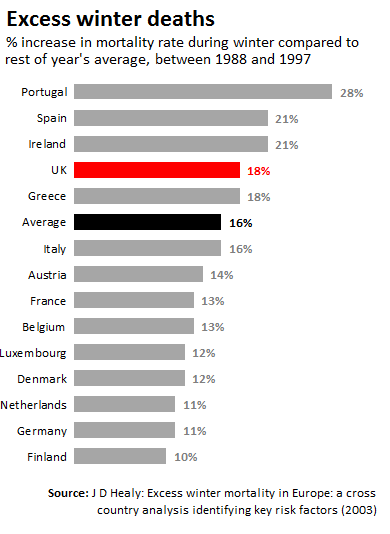
So is this just a case of bad weather? The graph gives away the first clue that it's not that simple. The countries with the highest 'seasonal variations' in deaths are Portugal and Spain, which hardly have the coldest climates on the list. Meanwhile northern European countries - Finland, Germany and the Netherlands - have comparatively few excess deaths.


The explanation for this is put down to differing levels of thermal efficiency. Warmer countries tended to have poorer standards of home insulation. Even looking at more recent figures for 2011, the case is similar: Scandinavian countries have high efficiency, Portugal and Spain less so.

https://www.ncbi.nlm.nih.gov/pmc/articles/PMC1732295/pdf/v057p00784.pdf#page=2 

Deadly heat waves becoming more common due to climate change

Deadly heat waves are going to be a much bigger problem in the coming decades, becoming more frequent and occurring over a much greater portion of the planet because of climate change, according to a study published last summer in Nature Climate Change.

https://www.theguardian.com/environment/2011/mar/17/deadly-heatwaves-europe

Extreme heat waves, such as the one torching the eastern United States, are frequently cited as one of the most direct effects of man-made climate change.

The study says, by the year 2100, three out of four people on Earth could be subject to at least 20 days per year of heat and humidity associated with deadly heat waves, if greenhouse emissions continue to rise at their current rates.

Up to 54 deaths linked to southern Quebec heat wave


Pakistan heatwave kills 65 people in Karachi - welfare organization

https://www.reuters.com/article/us-pakistan-heatwave/pakistan-heatwave-kills-65-people-in-karachi-welfare-organization-idUSKCN1IM2AU

- In Europe, heatwaves of the kind that occurred in 2003, killing more than 50,000 people, will become increasingly likely.

https://forskning.no/klima-ntb/ekstrem-varme-tar-livet-av-tusenvis-av-hjemlose-arlig/2047133?fbclid=IwAR2IDGVMh6kH6ClmlMhk2aUp1-ZUZ5BmUD-3Mo4sA_-l7GEJnfsitWtt-DI

Cold homes caused 9,000 deaths last winter, study suggests


An estimated 9,000 people died last winter in England and Wales as a result of living in a cold home, a university study has suggested. It found a fifth of the 43,900 excess winter deaths in 2014-2015 were caused by low indoor temperatures, BBC Panorama has learned.Cold homes increase the risk of respiratory infections, heart attacks and strokes, the researchers said.
Dr Allen said the figure was a shocking indictment on the current levels of fuel poverty.The charity Age UK estimates that fuel poverty, where people cannot afford to heat their home, costs the NHS around £1.3bn every year.

In 2000, the government agreed a legally-binding objective to eradicate fuel poverty by 2016.
But the target has been missed and official figures show there are still five million people living in cold homes.

The government used to define a household as fuel poor if they spent more than 10% of their income on heating their home, but the government changed how it measured fuel poverty in England in 2013.
The criterion for fuel poverty in England is now based on whether heating a home to a decent standard would leave the household below the poverty line.

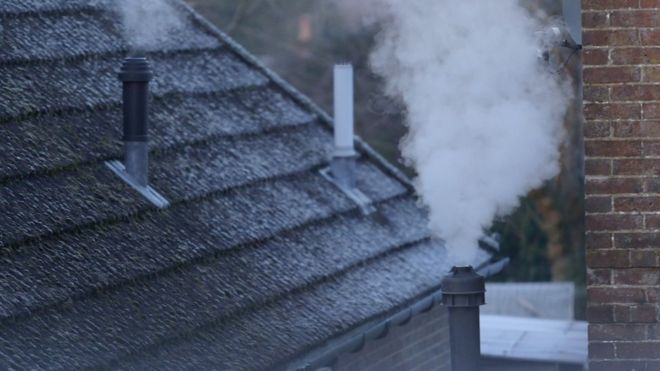
Smoke rising from chimney's on a cold day

People with less money are more vulnerable as they may not be able to afford to heat their home or may live somewhere that’s harder to keep warm because it’s not well insulated. Caravans or mobile homes are particularly risky.

I expect some climate change deniers will leap on this result and suggest we shouldn’t worry about extreme heat since the cold is a bigger killer. But this argument doesn’t hold.

On the other hand, it seems very likely that a warmer world will reduce the number of deaths due to cold. I’ve sensed some resistance to this prediction among some researchers, perhaps because they are reluctant to admit any potential benefit of climate change because of the ammunition it gives to the deniers.

Of course, the reduction in winter deaths could be wiped out by an increase in heat-related deaths. In every country studied in the Lancet paper, there was an increased risk of death during hot weather. Plus we should also consider the predicted increases in vector, food and water borne diseases, and the potentially catastrophic increase in global conflicts.

Premature deaths from both the heat and the cold are big problems that deserve our attention.

https://www.dagsavisen.no/nyheter/verden/2021/07/09/nesten-hvert-tiende-dodsfall-i-verden-skyldes-ekstreme-temperaturer/?fbclid=IwAR2Nc1CcZjEo4zlh5920rICADPbV5Zdj5Ge3nP445ig-1jCkeG89ik92xEM


Causes for the recent changes in cold- and heat-related mortality in England and Wales

https://link.springer.com/article/10.1007%2Fs10584-009-9774-0
 
http://www.thelancet.com/journals/lancet/article/PIIS0140-6736(14)62114-0/fulltext 

A study published last year in the journal WIRES Climate Change, however, lays out how the warming Arctic and melting ice appear to be linked to cold weather being driven farther south.

https://www.nbcnews.com/news/weather/why-climate-change-may-be-blame-dangerous-cold-blanketing-eastern-n834986

https://onlinelibrary.wiley.com/doi/full/10.1002/wcc.474


https://twitter.com/ret_ward/status/1181132839854788608

IPCC:

«Studies in temperate areas have shown that climate change is projected to bring some benefits, such as fewer deaths from cold exposure. Overall it is expected that these benefits will be outweighed by the negative health effects of rising temperatures worldwide, especially in developing countries».


Det blir som å si at røyking ikke er farlig fordi flere dør av andre årsaker. Denne artikkelen sammenblander epler og appelsiner.
Dødsfallene pga oppvarming er relatert til klimaet, mens dødsfallene relatert til kulde er for det meste IKKE det. Et annet poeng er at global oppvarming forander værmønsterer og sender kaldt vær innover områder som ikke er vant til dette. Mange dødsfall pga kulde skyldes dermed global oppvarming.
Europa:
Landene med de høyeste 'sesongvariasjonene' i dødsfall er Portugal og Spania, som neppe har det kaldeste klimaet i Europa. Samtidig har nord -europeiske land - Skandinavia, Finland, Tyskland og Nederland - relativt få dødsfall. Fordi vi er rike og har gode isolerte hjem, dør ikke folk i kulden her.
Folk dør pga kalde hjem og "brenselfattigdom". Personer med mindre penger er mer sårbare, ettersom de kanskje ikke har råd til å varme opp hjemmet sitt eller er tvunget til å bo et sted der det er vanskeligere å holde varmen fordi det ikke er godt isolert. Campingvogner eller bobiler er spesielt risikofylte.

IPCC:
«Studies in temperate areas have shown that climate change is projected to bring some benefits, such as fewer deaths from cold exposure. Overall it is expected that these benefits will be outweighed by the negative health effects of rising temperatures worldwide, especially in developing countries».


torsdag 25. januar 2018

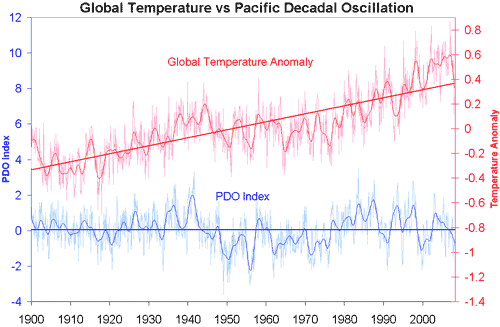
Natural oscillations: No credible study has suggested that ocean oscillations can account for the long-term trends.

Natural cycles can only move heat around, like from the oceans to the atmosphere. But now we see adding of heat both in oceans and the atmosphere. So the adding of heat to the energy budget we see now must come from somewhere else than natural cycles.

Natural oscillations like PDO simply move heat around from oceans to air and vice-versa. They don't have the ability to either create or retain heat, therefore they're not capable of causing a long-term warming trend, just short-term temperature variations. Basically they're an example of internal variability, not an external radiative forcing. If PDO were responsible for warming the surface, the oceans would be cooling, which is not the case.
These results are expected. The long term warming trend is a result of an energy imbalance caused primarily by an increase of greenhouse gases in the atmosphere. In contrast, the PDO is an internal process and does not increase or decrease the total energy in the climate system.
https://www.skepticalscience.com/Pacific-Decadal-Oscillation-advanced.htm


No credible study has suggested that ocean oscillations can account for the long-term trends. The key observation here is the increase in ocean heat content over the last half century (the figure below shows three estimates of the changes since 1955). This absolutely means that more energy has been coming into the system than leaving.
http://www.realclimate.org/index.php/archives/2017/04/judy-currys-attribution-non-argument/#comment-677575

Now this presents a real problem for claims that ocean variability is the main driver. To see why, note that ocean dynamics changes only move energy around – to warm somewhere, they have to cool somewhere else. So posit an initial dynamic change of ocean circulation that warms the surface (and cools below or in other regions). To bring more energy into the system, that surface warming would have to cause the top-of-the-atmosphere radiation balance to change positively, but that would add to warming, amplifying the initial perturbation and leading to a runaway instability. There are really good reasons to think this is unphysical.

Remember too that ocean heat content increases were a predicted consequence of GHG-driven warming well before the ocean data was clear enough to demonstrate it.


Arctic sea-ice decline weakens the Atlantic Meridional Overturning Circulation


onsdag 24. januar 2018

Klimarealistene og amatørfornekternes siste PR-stunt


Klimarealistene og amatørfornekternes siste PR-stunt er gamle forslitte forlengst debunkede fossil brensel-sponsete frontgruppe / tankesmie ekkokammer-blog propaganda-løgner resirkulert enda en gang. Gjesp. I dag er det Olga 69 som er tema.


Poenget med dette er at alle artikler i klimaområdet ikke nødvendigvis handler om klimaendringer, og hvorvidt de er menneskeskapte eller ikke. Da er det jo ikke naturlig å telle med dem. Svært liten andel av forskning innen fysikk bekrefter tyngdekraften. Dette betyr ikke at  tyngdekraften står svakt blant fysikere.

The point of this is that all articles in the climate area are not necessarily about climate change, and whether or not its man-made. Then it is not natural to count them in in a survey on how many papers supports the AGW theory.

Also, very few papers in physics research confirms gravity. This does not mean that gravity theory is weak among physicists.

Just because a paper on natural science does not mention or “confirm” the planet is a globe, this does not mean very few natural scientists thinks the planet is a globe.

Det såkalte 97% konsensus er bare tull skriver Einar R. Bordewich i en artikkel i Avisa Nordland. Javel. Har han funnet noe nytt som er blitt oversett tidligere?

Nei!

Hele artikkelen stinker lang vei og refererer til den konspiratoriske fornekterbloggen Popular Technology (bla a. kjent for å sverte Skeptikal Science) og den velkjente fornekterbloggen WUWT, som er selve edderkoppen i klimafornekter ekkokammer nettverket. Argumentene i artikkelen er forslitte resirkulerte løgner som har vært i omløp i åresvis.

Det handler ikke om å informere, bare om å så tvil og lage støy. I dette tilfellet er det og en del av den eviggående svertekampanjen mot nettstedet Skeptikal Science, som i mange år har vært en hovedfiende for de oljeindustri-sponsede tankesmiene og frontgruppene som utgjør de "proffe" klimafornektere (Climatedepot/CFACT, WUWT), som forer amatørfornekterne med artikler som disse skal spre videre i sosiale medier. Og det er jo påfallende at det er Cooks studie som igjen blir angrepet, selv om en rekke nyere studier bekrefter denne, ja til og med kommer frem til et enda høyere konsensus. Kommentarfeltet under artikkelen er selvsagt et ekkokammer av Klimakreasjonister..ehh...realister.


Det skrives:

"Hva er det så de faktisk finner? Jo at 66,4% av forskerrapportene ikke tar stilling til om klimaendringene er menneskeskapt eller ikke. (Antropogen Global Warming- AGW). Kun 32,6% av rapportene mener at AGW er en faktor - men faktoren kvantifiseres ikke, mens 0,7 % avviser AGW og 0,3% er usikker om den globale oppvarmingen er menneskeskapt i følge Cook et al."
 
Jeg har sett litt nærmere på tallene i artikkelen (32.6 %  og  66.4%) og visste jeg hadde sett resonnementet før. Jeg måtte bare komme på navnet....Richard Tol!!

https://www.desmogblog.com/richard-tol 

(Følger du linken til den bedritne fornekter-konspira bloggen Popular Technology (sic), dukker han jaggu opp i artikkelen.)

Tol, som tidligere har bidratt i Klimapanelet, og som nå jobber for fossil brensel klimafornekter tankesmien Global Warming Policy Foundation, skrev et papir som kritiserte Cook. Artikkelforfatteren resirkulerer bare Tols allerede avviste kritikk, (Tol 2014), som inneholder hele 24 til dels grove feil.

I motsetning til hva Richard postulerte, var det ikke et stort skifte fra AGW-godkjenning eller "tok ingen stilling til / nøytral" til avvisning av AGW.

Her er en forenklet illustrasjon for å vise hva Richards blunder resulterte i. Også den kvalitetssikrede bloggen HotWobber avkler beskyldningene og dette latterlige regnestykket her.


Med andre ord, hvor det var et skifte av kategori for et abstrakt, skiftet det bare litt i kategoriseringen (hovedsakelig fra eksplisitt til implisitt påtegning, eller implisitt til nøytral eller omvendt) - og om noe hadde forskerne en tendens til å lene til den konservative siden hvis det var en marginal beslutning. Det var knapt noen abstrakter som ble omklassifisert fra "nøytal" til avvisning, og ingen fra godkjenning til avvisning. Diagrammene viser at ut av 595 omklassifiserte abstrakter, ville bare fem papirer ha gått fra "nøytral" til "avvisning av AGW" og bare ett papir fra godkjent til å avvise.


Reply to ‘Quantifying the consensus on anthropogenic global warming in the scientific literature: A re-analysis

https://www.sciencedirect.com/science/article/pii/S0301421514003747

Her er gjennomgangen av alle 24 feil i angrepet på 97% konsensus.


Det ironiske er at Tol selv kom fram til tallet 91%, og han er jo egentlig enig i at det er et sterkt konsensus. Han sier:

"There is no doubt in my mind that the literature on climate change overwhelmingly supports the hypothesis that climate change is caused by humans.” and “It will take decades or longer to reduce carbon dioxide emissions to zero—the only way to stabilize its atmospheric concentration.”.

https://skepticalscience.com/climate-contrarians-accidentally-confirm-97-percent-consensus.html


En annen debunk:


Claims #1–4
"That [97% consensus] survey has of course been substantially discredited ... 35 percent of the abstracts were misclassified, and they were classified to the pro-global warming side. Professor Richard Tol ... has disassociated himself from that and said it's not reliable."
Verdict: False on all counts.
All of Neil's claims here refer to comments economist Richard Tol has made about our paper on his personal blog. He submitted those comments to the journal that published our paper, Environmental Research Letters, whose editor promptly rejected his submission. The editor noted that in addition to being "written in a rather opinionated style" and reading "more like a blog post than a scientific comment," most importantly,

"I do not see that the submission has identified any clear errors in the Cook et al. paper that would call its conclusions into question."
The claim that we "misclassified" 35 percent of abstracts is simply based on Tol's preference that our survey be less precise and make more sweeping generalizations. Our team read and categorized every abstract based on what they said about the causes of global warming, whereas Tol believes that every paper discussing the impacts of climate change should be placed in the 'no opinion' category. We classified these abstracts correctly based on the categories established in our study. Let's just take one quick example, from (Soulé 1992):
"Humans are engaged in an uncontrolled experiment in planetary heating. Each decade, the concentration of CO2, methane and other greenhouse gases in the atmosphere is increasing by about 4%. All signs point toward unprecedented rates of warming and climate change."
We categorized that as an explicit endorsement of human-caused global warming. Tol would call it "no opinion". You be the judge as to who's misclassified it.
Additionally, when we compared our abstract ratings to the authors' self-ratings based on their full papers, contrary to Neil's claim, we found that we had classified them more in the 'no opinion' category and less in the pro-human caused global warming categories than the authors themselves.


Histogram of Abstract Rating (expressed in percentages) minus Self-Rating. 1 = Explicit endorsement with quantification, 4 = No Expressed Position, 7 = Explicit rejection with quantification. Green bars are where self-ratings have a higher level of endorsement of AGW than the abstract rating. Red bars are where self-ratings have a lower level of endorsement of AGW than the abstract rating.
 Histogram of Abstract Rating (expressed in percentages) minus Self-Rating. 1–3 = endorsed human-caused global warming, 4 = no expressed position, 5–7 = rejected human-caused global warming. Green bars are where self-ratings have a higher level of endorsement of human-caused global warming than the abstract rating. Red bars are where self-ratings have a lower level of endorsement of human-caused global warming than the abstract rating.

Regarding Neil's claim that Tol has disassociated himself from our study: Tol has never been associated with the analysis of our study. He was one of 29,083 authors of studies that we examined, and one of 1,200 authors who participated in the self-rating phase. So the statement that he has disassociated himself is meaningless. His opinions about how his own papers should be categorized are included in the 97 percent consensus in self-rated papers.
Those author self-ratings are a key component of our study and conclusions. In both the abstract ratings and author self-ratings, we found the same 97 percent consensus result. Tol has only criticized the abstract ratings survey; even if you disregard those results, the 97 percent self-ratings consensus remains.
This is why our results remain widely accepted. Neil's assertion that they have been "widely discredited" is simply a repetition of baseless claims made on climate contrarian blogs. If Neil relies on contrarian blogs for his climate information, that may explain why he is woefully misinformed on the subject.
________________
For gøy, tenkte jeg å teste påstanden om at bare 0.3% av forskerne har en oppfatning at mer enn 50% av den globale oppfatningen er menneskeskapt, noe som påstås i https://link.springer.com/article/10.1007/s11191-013-9647-9. Dataene til Coock et all er på nettet, og en rask gjennomgang av dem med noen linjer i R gir......... trommehvirvel!..... 98%! Hvordan disse klimaskeptikerne teller, er et studium i seg selv. (Rasmus Benestad)

Cooks data er offentlig tilgjengelig her og her.
Quantifying the consensus on anthropogenic global warming in the scientific literature.

Den norske faktasjekkeren Faktisk.no debunker angrepet på 97% ganske lett:

https://www.faktisk.no/faktasjekker/gK2/66-prosent-av-verdens-klimaforskere-konkluderer-ikke-med-at-mennesker-kan-pavirke-klimaet

Værmelderen Anthony Watts er ikke spesielt god i matte. Han øker faktisk konsensus til 99.6%. Den kvalitetssikrete bloggen HotWhopper forklarer:

Anthony Watts has kindly pointed out that the scientific consensus on climate change is changing. He wrote the very strange headline: "‘The 97% climate consensus’starts to crumble with 485 new papers in 2017 that question it". Apparently some drongo (who does this every year IIRC) has only managed to dig up 485 "papers" that he claims " in some way questioned the supposed consensus regarding the perils of human CO2 emissions or the efficacy of climate models to predict the future."

I expect that, as in past collections, many of findings of those 485 don't dispute climate change, and many probably support the fact that human activity is causing global warming, but I haven't bothered checking (because that's not the point of this little article). What struck me was that 485 was a pretty small number given the vast number of peer-reviewed publications on climate change these days.

If you go to Google Scholar and search for the term "climate change" and select "2017-2017", you'll find there were "About 115,000 results". Now 485 is 0.4% of 115,000, so even if all those 485 papers disputed the greenhouse effect (which they don't), it would still mean that one could argue that 97% has become 99.6% :D

Now that even beats the 98.4% of WUWT-ers who deny straightforward science. Who'd have thought!


VIDERE:

Det pussige med kronikken er at den linker til fornekterbloggen WUWT og til en studie fra 2013 som tilsynelatende skal støtte artikkelforfatterens argument.

https://journals.ametsoc.org/doi/pdf/10.1175/BAMS-D-13-00091.1

Dette er en studie der American Meteorological Society sine medlemmer uttaler seg om de tror at klimaendringene er menneskeskapte eller ikke. Ifølge den fossil brensel sponsete Heartland Institute lobbyisten og værmelderen Anthony Watts, er det kun 52% av disse som tror på AGW.


BONUS: Se hvordan den fossil brensel sponete tankesmien Heartland Institute jobber med å undergrave vitenskap:
https://www.theguardian.com/environment/2012/feb/15/leak-exposes-heartland-institute-climate


Men denne studien viser at over 90% av AMS-medlemmer, som faktisk driver med klimarelatert forskning, mener oppvarmingen skyldes mennesker (en oppdatert versjon av studien fra 2016 viser enda større oppslutning).

https://gmuchss.az1.qualtrics.com/CP/File.php?F=F_cRR9lW0HjZaiVV3

Kronikkforfatterens egne kilder motsier altså påstandene hans.

HER ER NEMLIG HVA FORFATTERE AV DENNE STUDIEN SELV SIER OM SIN EGEN STUDIE:

Statement by Neil Stenhouse, Edward Maibach, Sara Cobb, Ray Ban, Paul Croft, Keith Seitter, and Anthony Leiserowitz:

"James Taylor’s interpretation of our study is wrong. We found high levels of expert consensus on human-caused climate change."


https://independentaustralia.net/environment/environment-display/the-australians-continued-support-of-climate-change-denialism,12088

We also found that about 8 out of 10 meteorologists and atmospheric scientists who publish on climate (79%) or other topics (78%) were convinced that humans have contributed to global warming. Lastly, we found that the group least likely to be convinced that humans have contributed to global warming was AMS members who do not publish research in the peer-reviewed scientific literature; only six out of 10 AMS members in this group (62%) were convinced."


"First and foremost, our study is not a representative survey. Although our data set is large and diverse enough for our research questions, it cannot be used for generalizations such as “respondents believe …” or “scientists don’t believe …” Our research reconstructs the frames the members of a professional association hold about the issue and the argumentative patterns and legitimation strategies these professionals use when articulating their assumptions. Our research does not investigate the distribution of these frames and, thus, does not allow for any conclusions in this direction. We do point this out several times in the paper, and it is important to highlight it again.

In addition, even within the confines of our non-representative data set, the interpretation that a majority of the respondents believe that nature is the primary cause of global warming is simply not correct. To the contrary: the majority believes that humans do have their hands in climate change, even if many of them believe that humans are not the only cause. What is striking is how little support that the Kyoto Protocol had among our respondents. However, it is also not the case that all frames except “Support Kyoto” are against regulation – the “Regulation Activists” mobilize for a more encompassing and more strongly enforced regulation. Correct interpretations would be, for instance, that – among our respondents – more geoscientists are critical towards regulation (and especially the Kyoto Protocol) than non-geoscientists, or that more people in higher hierarchical positions in the industry oppose regulation than people in lower hierarchical positions."
https://www.denialism.com/2013/02/15/denialism-from-forbes-courtesy-of-heartland-hack-james-taylor/ 

Dette får altså Watts til å bli bare 52%. Forstå det den som kan. Tallene i studeier ER faktisk i samsvar med hva den fagfellevurderte literaturen mener om AGW. Husk at konsensus er ikke en meningsmåling, men et tall på hvor mye av den fagfellevurderte literaturen som faktisk støtter teorien om AGW.

Bloggen HotWopper debunker Watts uærlighet veldig brutalt. Her er de korrekte tallene:

New survey shows more AMS members accept global warming 
There was a report of a survey of American Meteorological Society (AMS) members published a couple of years ago, which deniers touted quite a bit. It showed that the least well-informed about climate science were also the least likely to accept that humans are causing global warming. Just released are the initial results of another survey of AMS members by some of the same researchers. It's not exactly a repeat, but the questions are not dissimilar. They are close enough for a comparison I believe. There's been a shift toward understanding climate science among AMS members since the first survey was conducted.

The first thing I noticed was that participation in the survey more than doubled this time around. There was a very good response rate from AMS members with 4,092 responding to this years' survey compared to 1,854 in 2014:


The actual questions and responses for the 2016 survey are shown below. The big improvement is that the question is timebound, not open to many and varied interpretations, which was one of the concerns with the previous survey:


There are more nuanced and detailed questions in the survey, which you can download here. This includes questions about mitigation, and questions on the shift in thinking of AMS members over the past couple of years. Eighty seven per cent (87%) of the 17% who had changed their thinking said they were now more convinced that human-caused climate change is happening. Thirteen per cent were less convinced.

The next time some denier quotes the old AMS survey results at you, you can now point them to this latest one showing that a not insignificant number of AMS members have learnt something more about climate change in the past couple of years.

Stenhouse, Neil, Edward Maibach, Sara Cobb, Ray Ban, Andrea Bleistein, Paul Croft, Eugene Bierly, Keith Seitter, Gary Rasmussen, and Anthony Leiserowitz. "Meteorologists' views about global warming: A survey of American Meteorological Society professional members." Bulletin of the American Meteorological Society 95, no. 7 (2014): 1029-1040. DOI: http://dx.doi.org/10.1175/BAMS-D-13-00091.1 (open access)

Maibach, E., Perkins, D., Francis, Z., Myers, T., Englbom, A., et al. (2016) A 2016 National Survey of American Meteorological Society Member Views on Climate Change: Initial Findings. George Mason University, Fairfax, VA: Center for Climate Change Communication. (pdf here)

The America Meteorological Society er 100% bak teorien om de menneskeskapte klimaendringene og senest i oktober 2018 skrev de dette brevet til President Trump:

"There is an overwhelming body of scientific evidence that shows that the warming global climate we have been experiencing in recent decades is primarily caused by human activity and that current long-term warming trends cannot be expected to reverse if no action is taken. These conclusions come from multiple independent lines of evidence. As is standard for the scientific process, each of these lines of evidence has undergone rigorous testing and has overcome all credible challenges. They reinforce one another and there are no contradictory lines of evidence that withstand scientific scrutiny. As a result, the basic scientific conclusions about climate change are extremely robust."

https://www.ametsoc.org/index.cfm/ams/about-ams/ams-position-letters/letter-to-president-trump-on-climate-change/

https://www.ametsoc.org/index.cfm/ams/


MEN HVA ER SANNHETEN OM KONSENSUS NÅ?

Vi trenger ikke engang Cook for å finne et konsensus over 97%. En rekke nyere studier bekrefter en konsensus på over 99%. Nå er også de fleste oljeselskapenes egne forskere og eksperter enige om AGW!
 
The consensus among publishing scientists is demonstrably not 97%. Instead, five surveys of the peer-reviewed literature from 1991 to 2015 combine to 54,195 articles with an average consensus of 99.94%.

http://journals.sagepub.com/doi/pdf/10.1177/0270467617707079

During 2013 and 2014, only 4 of 69,406 authors of peer-reviewed articles on global warming, 0.0058% or 1 in 17,352, rejected AGW. Thus, the consensus on AGW among publishing scientists is above 99.99%, verging on unanimity.[...] The peer-reviewed literature contains no convincing evidence against AGW.

http://www.rescuethatfrog.com/wp-content/uploads/2017/01/Powell-2015.pdf


The consensus did not arise from a vote or a gathering. It speaks to the evidence. Scientists come to a consensus after a convergence of evidence leaves no significant doubt about a result. It happens a lot in science. There is a consensus that the speed of light is the universe's speed limit. Scientists didn't vote on that or gather to agree and find evidence to support that agreement. They came to consensus after the research from multiple independent lines of evidence converged.The same process has taken place in climate science. Scientists didn't vote on the validity of AGW or come together and agree before the evidence came in. They came to consensus based upon multiple independent lines of evidence converged to support AGW.

Konsensusen oppsto ikke ved en avstemming eller i en forsamling. Det er en direkte konsekvens av bevisene. Forskere kommer til enighet etter at en konvergens av bevis ikke gir noen vesentlig tvil om et resultat. Det skjer ofte i vitenskapen. Det er enighet om at lysets hastighet er universets fartsgrense. Forskere stemte ikke på det eller samlet seg for å bli enige og finne bevis for å støtte denne avtalen. De kom til konsensus etter at forskningen fra flere uavhengige beviser ble samlet. Den samme prosessen har skjedd i klimavitenskap. Forskere stemte ikke for AGWs gyldighet eller kom sammen og var enige før bevisene kom inn. De kom til konsensus basert på flere uavhengige bevislinjer som konvergeres for å støtte AGW.

Det finnes ikke en eneste vitenskapelig institutt, akademi eller organisasjon internasjonalt som ikke støtter teorien om at mennesker bidrar nå mest til klimaendringer. Nærmere 200 av klodens nasjoner har erklært at de vil bidra til å bekjempe oppvarmingen. USA står faktisk helt alene utenfor. 


Hvorfor?


https://www.washingtonpost.com/news/energy-environment/wp/2017/04/14/trumps-epa-chief-scott-pruitt-calls-for-an-exit-to-the-paris-climate-agreement/?utm_term=.aa979f55f642

https://mic.com/articles/178727/paris-climate-deal-senators-who-urged-trump-to-leave-took-millions-from-oil-companies#.TQjtfQ2ek

https://www.theguardian.com/environment/2017/feb/22/scott-pruitt-emails-oklahoma-fossil-fuels-koch-brothers


Hva sier oljeselskapene?:

BP :

"As scientists and engineers, BP recognizes the urgency of the climate challenge - and we intend to be part of the solution. We are calling for a price on carbon, increasing gas in our upstream portfolio, investing in renewables and low carbon innovation, and pursuing energy efficiency."

STATOIL:

At Statoil we believe that you can put a price on carbon. In fact we have to because it is one of the most effective ways to combat climate change. The impact of climate change is becoming more severe and noticeable: ice caps are melting, water is becoming scarce in some places, many fish and animal species face extinction, and heat waves are becoming the norm.

SHELL

 
We recognise the significance of climate change, along with the role energy plays in helping people achieve and maintain a good quality of life. A key role for society – and for Shell – is to find ways to provide much more energy with less carbon dioxide. Our lives depend on energy wherever we live. But in order to prosper while tackling climate change, society needs to provide much more energy for a growing global population while finding ways to emit much less CO2.

SINOPEC, from China

Climate change is a major global issue for all humankind. As a responsible energy and petrochemical company, Sinopec regards it as its due responsibility to fight against climate change. We make efforts to shift the pattern of growth, optimize energy structure, develop and utilize low-carbon energy resources and promote energy saving and consumption reduction. We are speeding up study on commercial test of CO2 recovering, in order to reduce GHG emissions and better prepare to combat climate change.


EXXON-MOBIL:

Our position on climate change:
We have the same concerns as people everywhere – and that is how to provide the world with the energy it needs while reducing greenhouse gas emissions. The risk of climate change is clear and the risk warrants action. Increasing carbon emissions in the atmosphere are having a warming effect. There is a broad scientific and policy consensus that action must be taken to further quantify and assess the risks.

PETROBAS (Brazil)

Several studies indicate that increased greenhouse gas (GHG) emissions associated to the energy and transport sectors is a consequence of the surging consumption of energy, especially coming from fossil fuels. Therefore, we are committed to understand the impact our activity has on climatic conditions and to deploying measures to mitigate them.

https://rogerfjellstadolsen.blogspot.no/2017/07/hva-er-de-strste-oljeselskapenes.html


https://www.vox.com/energy-and-environment/2018/3/28/17152804/climate-change-federal-court-chevron

https://www.huffingtonpost.com/entry/climate-change-trial-california_us_5ab53d0ce4b054d118e2a0d9

https://www.theguardian.com/environment/climate-consensus-97-per-cent/2018/mar/23/in-court-big-oil-rejected-climate-denial?CMP=share_btn_fb


BONUS: Hvorfor konsensus har økt fra 97% og opp til over 99%:

For hva med den fagfellevurderte klimavitenskapen som går imot konsensus? Blir disse studiene hørt? Ja. Forskerne ser også på disse, men det viser seg at de ikke holder mål. Her er 38 studier fra de siste 10 årene. 

Alle disse 38 studiene hadde alvorlige feil og mangler. 
Les om dette her:


tirsdag 23. januar 2018

"MYTH #26 "THEY" CHANGED THE NAME FROM "GLOBAL WARMING" TO "CLIMATE CHANGE"


They” changed the term “global warming” to “climate change” because the planet is not warming is an oft-repeated talking point of those, such as President Trump, who cast doubt on the reality of rising temperatures.This claim is demonstrably incorrect, never mind that it’s unclear who “they” are.

The planet just had its hottest 4 years in recorded history. Trump is dismantling efforts to fight climate change.

https://climate.nasa.gov/climate_resources/9/


There have long been claims that some unspecificed "they" has "changed the name from 'global warming' to 'climate change'". In reality, the two terms mean different things, have both been used for decades, and the only individual to have specifically advocated changing the name in this fashion is a global warming 'skeptic'.


Lets see some examples to how the"climate change" term have been in use over the last 100 years:

1896:


http://www.rsc.org/images/Arrhenius1896_tcm18-173546.pdf


1912

Bildet kan inneholde: tekst

https://www.snopes.com/1912-article-global-warming/

https://paperspast.natlib.govt.nz/newspapers/ROTWKG19120814.2.56.5


1932
DR. E. O. HULBURT climate change


1938

http://www.met.reading.ac.uk/~ed/callendar_1938.pdf


1955

http://cvining.com/system/files/Plass-Tellus-1956.pdf


1969 

https://link.springer.com/article/10.1007/BF02243163 

 1978


http://climate.envsci.rutgers.edu/pdf/RobockInternalExternalJAS1978.pdf

1998 


NASA knows rocket science and climate science (having pioneered the research in both).


NASA knows the difference between global warming and climate change, too.

NASA is smart.

You can be smart, too.

Like NASA.


"Hot mess’ paper questioning CO2 and climate change gets retracted

A paper that called into question many central data linking carbon dioxide to the rapidly warming climate has been retracted for “significan...