This blog uses the best up-to-date peer-reviewed climate science, quality sources, logic and critical thinking to explain man-made climate change and to debunk fake news, propaganda, myths and conspiracy theories.
Bloggen bruker den beste oppdaterte fagfellevurderte klimavitenskapen, kildekritikk og kritisk tenking til å forklare de menneskeskapte klimaendringene og til å svare på falske nyheter, propaganda, myter, konspirasjonsteorier og alternative virkelighetsoppfatninger om klima.
The claim that Leonardo and his ilk are hypocrites is a classic conservative attack strategy of redirection (because it ignores the core issue of climate change) and of poisoning the well (because it attempts to discredit the message by discrediting the messenger).This is much easier, and perhaps more rhetorically effective, than debunking climate science itself
And isnt it convenient?
If DeCaprio doesn’t invest in green energy companies, you call him a hypocrite who isn’t willing to put his money were his mouth is. If he does, you accuse him of having a conflict of interest. Either way, you get to avoid actually considering what he’s saying.
He could live in a mud hut and walk everywhere and they'd call him a hypocrite because the aglets on his shoelaces were made of plastic, a petroleum product.
And behold:
The Michael Jordan Fallacy
This one can be used to impugn the motives of anyone in the world, in an effort to prove they are driven by greed and don't care about anyone else's problems:
"Just think if Michael Jordan had used all his talents and wealth to feed third world children, rather than to play a sport."
Of course, you can say this about anyone, famous or not:
"If your doctor really cared about people's health, he'd sell everything he owned and become a charitable frontier doctor in Africa."
Remarkably, CO2's role in global warming has been on the oil industry's radar since the 1950's:
"In 1954, the geochemist Harrison Brown and his colleagues at the California Institute of Technology submitted a research proposal to the API entitled “The determination of the variations and causes of variations of the isotopic composition of carbon in nature.” The scientists proposed the use of new mass spectrometers to investigate the ratio of carbon-12 to carbon-13 in terrestrial, marine and mineral systems to understand geological and biological carbon cycling.
The team had already carried out preliminary work, including on tree rings of various ages. “Perhaps the most interesting effect concerning carbon in trees which we have thus far observed,” the researchers reported to the API, “is a marked and fairly steady increase in the 12C/13C ratio with time.” The results indicated that fossil fuels had caused atmospheric CO2 concentrations to rise by about 5% over the past century. Brown’s estimate was quite accurate: from 1854 to 1954, global CO2 concentrations had risen by 10% (from around 285 to 313 ppm), with about 4% of that from fossil fuels and the remainder from deforestation and other land-use changes.
A few years later, in 1959, petroleum industry leaders were notified of the danger of CO2 accumulation by the physicist Edward Teller, who warned them of global temperature and sea-level rise by the end of the century. Thus, even before early portions of the Keeling curve were published in 1960, leaders of the API and other segments of the oil industry were informed that fossil fuel products were causing atmospheric CO2 concentrations to rise, and that such a rise was potentially dangerous."
On its 100th birthday in 1959, Edward Teller warned the oil industry about global warming:
"Ladies and gentlemen, I am to talk to you about energy in the future. I will start by telling you why I believe that the energy resources of the past must be supplemented. First of all, these energy resources will run short as we use more and more of the fossil fuels. [....] But I would [...] like to mention another reason why we probably have to look for additional fuel supplies. And this, strangely, is the question of contaminating the atmosphere. [....] Whenever you burn conventional fuel, you create carbon dioxide. [....] The carbon dioxide is invisible, it is transparent, you can’t smell it, it is not dangerous to health, so why should one worry about it?
Carbon dioxide has a strange property. It transmits visible light but it absorbs the infrared radiation which is emitted from the earth. Its presence in the atmosphere causes a greenhouse effect [....] It has been calculated that a temperature rise corresponding to a 10 per cent increase in carbon dioxide will be sufficient to melt the icecap and submerge New York. All the coastal cities would be covered, and since a considerable percentage of the human race lives in coastal regions, I think that this chemical contamination is more serious than most people tend to believe.
At present the carbon dioxide in the atmosphere has risen by 2 per cent over normal. By 1970, it will be perhaps 4 per cent, by 1980, 8 per cent, by 1990, 16 per cent [about 360 parts per million, by Teller’s accounting], if we keep on with our exponential rise in the use of purely conventional fuels. By that time, there will be a serious additional impediment for the radiation leaving the earth. Our planet will get a little warmer. It is hard to say whether it will be 2 degrees Fahrenheit or only one or 5.
But when the temperature does rise by a few degrees over the whole globe, there is a possibility that the icecaps will start melting and the level of the oceans will begin to rise. Well, I don’t know whether they will cover the Empire State Building or not, but anyone can calculate it by looking at the map and noting that the icecaps over Greenland and over Antarctica are perhaps five thousand feet thick."
Time is Running Out,' American Petroleum Institute Chief Said in 1965 Speech on Climate Change:
“This report unquestionably will fan emotions, raise fears, and bring demand for action,” the president of the American Petroleum Institute (API) told an oil industry conference, as he described research into climate change caused by fossil fuels.
“The substance of the report is that there is still time to save the world's peoples from the catastrophic consequence of pollution, but time is running out.”"
The oil industry's leading pollution-control consultants advised the American Petroleum Institute in 1968 that carbon dioxide from burning fossil fuels deserved as much concern as the smog and soot that had commanded attention for decades.
Carbon dioxide was "the only air pollutant which has been proven to be of global importance to man's environment on the basis of a long period of scientific investigation," two scientists from the Stanford Research Institute (SRI) told the API.
This paper, along with scores of other publications, shows that the risks of climate change were being discussed in the inner circles of the oil industry earlier than previously documented. The records, unearthed from archives by a Washington, D.C. environmental law organization, the Center for International Environmental Law (CIEL), reveal that the carbon dioxide question—an obscure corner of research for much of the 20th century—had been closely studied since the 1950s by some oil company researchers."
'Sources, abundance, and fate of atmospheric pollutants'
"In 1968, Stanford Reseach Institute (SRI) scientists Elmer Robinson and R.C. Robbins produced a Final Report to the American Petroleum Institute (API) on SRI’s research in the sources, abundance, and fate of gaseous pollutants in the atmosphere. They reserved their starkest warnings to industry leaders for carbon dioxide. Robinson observed that, among the pollutants reviewed, carbon dioxide "is the only air pollutant which has been proven to be global importance to man's environment on the basis of a long period of scientific investigation."
Summarizing the findings of the President’s Science Advisory Council, Robinson noted that CO2 emissions from fossil fuels were outstripping the natural CO2 removal processes that keep the atmosphere in equilibrium. He noted that the speed of CO2 accumulation would depend on fossil fuel consumption and projected that, on then-present trends, atmospheric CO2 could reach 400ppm by 2000, and that exploiting all then-recoverable fossil fuel would lead to concentrations of 830ppm.
The report warned that rising CO2 would result in increases in temperature at the earth's surface, and that significant temperature increase could lead to melting ice caps, rising seas, and potentially serious environmental damage worldwide. It noted that, even if Antarctic ice caps took 1000 years to melt, this would mean sea level rises of four feet per ten years—"100 times greater than observed changes."
Importantly, SRI acknowledged that of the various sources proposed for rising atmospheric CO2, "none seems to fit the presently observed situation as well as the fossil fuel emanation theory."
Noting uncertainties about whether particulate pollution would offset some of this warming, SRI warned "…there seems to be no doubt that the potential damage to our environment could be severe…" The industry's own consulting scientists then confirmed that the most urgent research need was into technologies that could bring CO2 emissions under control." https://www.smokeandfumes.org/documents/document16 Exxon's own research confirmed fossil fuels' role in global warming, decades ago:
"a doubling of the carbon dioxide (CO2) concentration in the atmosphere would increase average global temperatures by 2 to 3 degrees Celsius (4 to 5 degrees Fahrenheit), and as much as 10 degrees Celsius (18 degrees Fahrenheit) at the poles"
And
"Some countries would benefit but others would have their agricultural output reduced or destroyed"
To sum, Exxon, circa 1980:
1) Accepted the CO2 effect.
2) Accepted ECS near +3 C.
3) Accepted that a consensus on AGW had emerged.
4) Accepted that prior to 2030 there would be hazardous impacts, with the possibility of catastrophic impacts beyond that.
"The risk of climate change is clear and the risk warrants action. Increasing carbon emissions in the atmosphere are having a warming effect. There is a broad scientific and policy consensus that action must be taken to further quantify and assess the risks."
Exxon's Oil Industry Peers Knew About Climate Dangers in the 1970s, Too
"Members of an American Petroleum Institute task force on CO2 included scientists from nearly every major oil company, including Exxon, Texaco and Shell"
And"Laurmann estimated that the amount of CO2 in the atmosphere would double in 2038, which he said would likely lead to a 2.5 degrees Celsius rise in global average temperatures with "major economic consequences." He then told the task force that models showed a 5 degrees Celsius rise by 2067, with "globally catastrophic effects.""
The industry then sowed doubt for decades about climate science, spending $2.9 billion on advocacy advertising alone in a 10-year period ending in 2015.
"ExxonMobil, the world’s biggest oil company, knew as early as 1981 of climate change – seven years before it became a public issue, according to a newly discovered email from one of the firm’s own scientists. Despite this the firm spent millions over the next 27 years to promote climate denial."
And
"the company was aware of the connection between fossil fuels and climate change, and the potential for carbon-cutting regulations that could hurt its bottom line"
Exxon Mobil misled the public about the state of climate science and its implications. Available documents show a systematic, quantifiable discrepancy between what Exxon Mobil’s scientists and executives discussed about climate change in private and in academic circles, and what it presented to the general public."
Shell Oil's documentary from 1991, explaining global warming and sea level rise, how it will happen, and what to do about it.
Newly found documents from the 1980s show that fossil fuel companies privately predicted the global damage that would be caused by their products.
In the 1980s, oil companies like Exxon and Shell carried out internal assessments of the carbon dioxide released by fossil fuels, and forecast the planetary consequences of these emissions. In 1982, for example, Exxon predicted that by about 2060, CO2 levels would reach around 560 parts per million – double the preindustrial level – and that this would push the planet’s average temperatures up by about 2°C over then-current levels (and even more compared to pre-industrial levels).
Later that decade, in 1988, an internal report by Shell projected similar effects but also found that CO2 could double even earlier, by 2030. Privately, these companies did not dispute the links between their products, global warming, and ecological calamity. On the contrary, their research confirmed the connections.
Shell’s assessment foresaw a one-meter sea-level rise, and noted that warming could also fuel disintegration of the West Antarctic Ice Sheet, resulting in a worldwide rise in sea level of “five to six meters.” That would be enough to inundate entire low-lying countries.
Shell’s analysts also warned of the “disappearance of specific ecosystems or habitat destruction,” predicted an increase in “runoff, destructive floods, and inundation of low-lying farmland,” and said that “new sources of freshwater would be required” to compensate for changes in precipitation. Global changes in air temperature would also “drastically change the way people live and work.” All told, Shell concluded, “the changes may be the greatest in recorded history.”
For its part, Exxon warned of “potentially catastrophic events that must be considered.” Like Shell’s experts, Exxon’s scientists predicted devastating sea-level rise, and warned that the American Midwest and other parts of the world could become desert-like.
https://skepticalscience.com/shell-exxon-secret-1980s-climate-warnings.html
Exxon predicted in 1982 exactly how high global carbon emissions would be today, predicting that a continued usage of fossil fuels would see atmospheric concentrations of CO2 reach today's levels by 2020. According to an internal 1982 document from Exxon Research and Engineering Company — obtained by InsideClimate News as part of its 2015 investigation into what Exxon knew about the impact of fossil fuels on climate change — the company was modeling out the concentration of carbon emissions several years into the future.
According to a graph displaying the “growth of atmospheric CO2 and average global temperature increase” over time, the company expected that, by 2020, carbon dioxide in the atmosphere would reach roughly 400 to 420 ppm. This month’s measurement of 415 ppm is right within the expected curve Exxon projected under its “21st Century Study-High Growth scenario.”
Not only did Exxon predict the rise in emissions, it also understood how severe the consequences would be:
“Considerable uncertainty also surrounds the possible impact on society of such a warming trend, should it occur,” the internal document stated. “At the low end of the predicted temperature range there could be some impact on agricultural growth and rainfall patterns which could be beneficial in some regions and detrimental in others.” “At the high end, some scientists suggest there could be considerable adverse impact including the flooding of some coastal land masses as a result of a rise in sea level due to melting of the Antarctic ice sheet,” it continued, stating this would only take place centuries after temperatures warmed by 3 degrees Celsius.
"About $2.08 billion (in 2016 dollars) was spent on climate lobbying between 2000 and 2016. This is about 3.9 percent of total lobbying dollars spent of $53.5 billion. The electrical sector spent 26 percent of the total. The fossil fuel sector spent 17.7 percent, and the transportation sector 12.1 percent." By contrast:
"Lobbying expenditures from 2000 to 2016 for environmental and renewable energy groups amounted to only five to seven percent of the total, or less than $145 million."
And "lobbying for and against climate legislation in this period was about evenly split, indicating that anti-climate change players were once again playing both sides of the discussion in an attempt to promote a false, or at least an unseeming support of climate legislation"
And "This analysis also illustrates the limitations of science advocacy efforts. Climate lobbying expenditures by environmental organizations constitute only 3% of total lobbying expenditures… There is no open debate or refutation of viewpoints offered by professional lobbyists meeting in private with government officials. Hence, control over the nature and flow of information to government decision-makers can be significantly altered by the lobbying process, and creates a situation of systematically distorted communication."
For nearly three decades, many of the world's largest fossil fuel companies have knowingly worked to deceive the public about the realities and risks of climate change.
"In 2017, the world subsidized fossil fuels by $5.2 trillion, equal to roughly 6.5 percent of global GDP. That’s up half a trillion dollars from 2015, when global subsidies stood at $4.7 trillion, according to the IMF."
Wave of climate lawsuits threatens the future of Big Oil https://apps.publicintegrity.org/.../venue-of-last-resort/ The petroleum extraction companies researched the subject themselves and affirm the unassailable facts, physics and evidence of AGW.Per the oil companies, which admitted it in court, under oath:
"The issue is not over science. All parties agree that fossil fuels have led to global warming and ocean rise and will continue to do so, and that eventually the navigable waters of the United States will intrude upon Oakland and San Francisco. "The People of the State of California vs BP PLC et al (page 6, line 6).
"Climategate" var en konstruert "kontrovers" skapt av fossilt brensel- interesser og fornekterbevegelsen- timet spesielt for å forstyrre klimaforhandlingene 2009 og 2011 og Cap and Trade-avtalen i USA.
Her er hva som skjedde:
Hackede e-poster tatt ut av sin sammenheng, distribuert fra en russisk server og videre til ekkokammeret av fornekterblogger og tenketanker og høyreorienterte medier som Fox News der alle hadde et forberedt manus?
HALLO??????????
KOM IGJEN!!
Tenk.
Og ikke le nå, men rett før neste globale klimakonferanse, FNs klimakonferanse i Durban, Sør-Afrika 28. november 2011, ble en ny serie på 5000 hackede e-poster lagt ut på en russisk server. Igjen blir e-postene kommunisert via linker i kommentarfeltene i blogger.
Den kanadiske nyliberianske tenketanken, Frontier Center for Public Policy, som angrep forskerne, har nå innrømmet at de tok feil og har bedt Michael E. Mann om unnskyldning.
Hvorfor Michael E.Manns "hockeykølle er kommet for å bli:
Den er akseptert av US National Academy of Sciences (NAS)
Den er er bekreftet og forbedret av 4 mest omfattende studiene på proxy-data (+ ca 200 andre studier).
Alle data er reprodusert i ettertid og bekreftet av ALL nyere forskning.
"The Independent Climate Change Email Review went back to primary data sources and were able to replicate CRU's results. This means not only was CRU not hiding anything, but it had nothing to hide. Though CRU neglected to provide an exact list of temperature stations, it could not have hid or tampered with data."
The Independent Climate Change Email Review gikk tilbake til primære datakilder og klarte å gjenskape CRUs resultater. Dette betyr at CRU ikke skjulte noe, og at de ikke hadde noe å skjule heller.
Hvorfor skulle noen "hide the decline" i en tid hvor alle tilgjengelige temperaturdata viste raskt oppvarming? Det hadde ikke skjedd noen nedgang i de globale temperaturene.
Studie: NASAs estimat av jordas langsiktige temperaturøkning de siste tiårene er nøyaktig til i løpet av mindre enn en tidel av en grad av Fahrenheit, og gir tillit til at tidligere og fremtidig forskning fanger riktig stigende overflatetemperaturer.
Studien bekrefter også hva forskere har sagt i noen tid nå: at jordas globale temperaturøkning siden 1880 - omtrent 2 grader Fahrenheit, eller litt mer enn 1 grad Celsius - ikke kan forklares med noen usikkerhet eller feil i dataene.
Fremover vil denne vurderingen gi forskere verktøyene til å forklare resultatene med større selvtillit. Nye studier øker tilliten til NASAs måling av jordens temperatur.
Satellittdataene fra UAH, drevet av kjente "skeptikere" John Christy og Roy Spencer, viser den samme trenden som alle de andre dataene. John Christy og Roy Spencer sier nå at planeten virkelig blir oppvarmet, og bekrefter at det hele var en konstruert "kontrovers".
7 minutter inn i videoen bekrefter Christy og Spencer at dataene var korrekte.
Hvilken trend viser UAH dataene til Christy og Spencer nå?
While the Earth's magnetic axis is shifting somewhat, Earth's rotational axis shifts only a little bit, mostly in response to the mass redistribution of water around the Earth from land-based ice sheet losses. This is a normal response.
The net change in the position of the Earth's rotational axis is about 37 feet. The largest annual change is about 7 inches.
If you move over 37 feet, the climate doesn't change. It changes even less per year if you only move 7 inches.
"What would happen if the magnetic field of the Earth suddenly changed?
If the magnetic field of the Earth suddenly changed, and this DOES happen naturally every 250,000 years or so, the consequences would be fascinating. For life, we can see from the fossil record that the past field changes had no significant effect on living organisms. This is most curious because the field reversal ( North magnetic pole shifting to antarctica and the South magnetic pole shifting to the arctic region in the Northern Hemisphere) one might expect the field to go to zero strength for a century or so. This would let cosmic rays freely penetrate to the Earth's surface and cause mutations. This seems not to have had much effect in the past, so we probably don't really know what is going on during these field reversals. There have been a dozen of them over the last few million years, documented in the rock which has emerged and solidified along the mid-Atlantic Ridge where continental plates are slowly separating. These epochs form parallel bands all long the ridge where the rock has stored a fossilized image of the local orientation of the Earth's magnetic field for the last few million years.
Magnetic field wandering would let the aurora borealis occur at any latitude, but other than that there would be no noticeable effects other than changes in the amount of cosmic rays that penetrate to the ground. Even this effect is minimal because we can visit the Arctic and Antarctic and only receive a slight increase in cosmic rays. So long as the strength of the field remains high during this field wandering event, the effects should be pretty benign.
"one total bonus of having a weaker magnetic field is that auroras will be visible from much lower latitudes, so the nighttime skies will be even more epic"
Mid-century cooling in the 20th Century: skeptics point to it and ask about it. What's the real story?
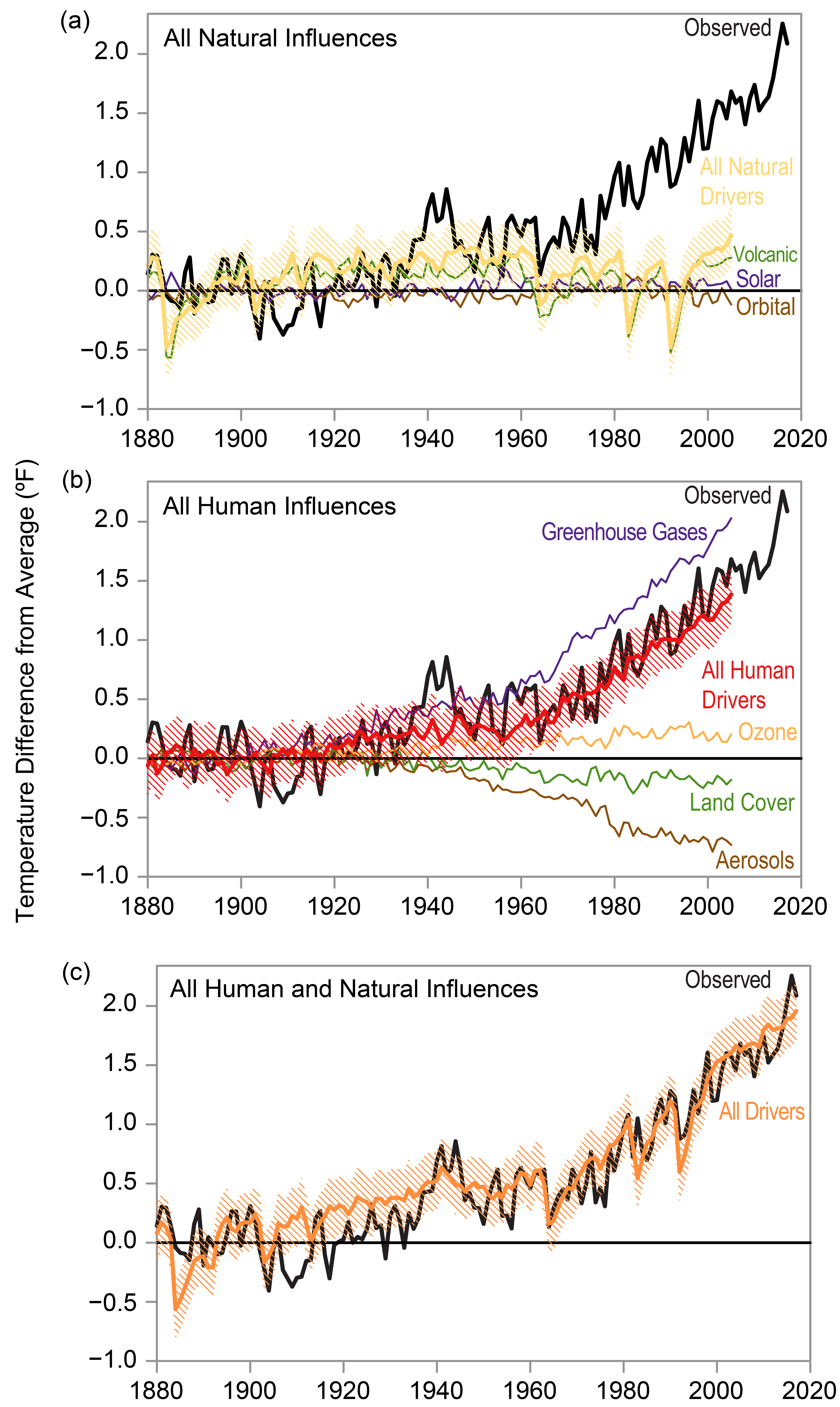
As a preface, scientists have evaluated all natural forcings and factors capable of driving the Earth's climate to change and it is only when the anthropogenic forcing is included that the ongoing observed warming can be explained.
Natural vs Anthropogenic Climate Forcings, per the NCA4, Volume 2:
Digging into the question, early 20th Century warming (1910-1940) was about one-third caused by human activities. The rest of that was a combination of natural factors. Starting in the war years (1940) and continuing through the 1970s, sulfate aerosol emissions (which act to reflect incoming sunlight, cooling the Earth’s surface) combined with natural cooling held daytime temperatures flat, despite increasing CO2 and other GHG emissions from human activities. However, during this time nighttime low temperatures continued to increase, a hallmark confirmation of the combined effects of increases in GHG emissions from human activities coupled with sulfate aerosol emissions from industrial activities (the explosions during WW2 and the post-war reconstruction boom in industrial activities).
Looking at the temperature trends of both the Northern and Southern Hemispheres, if both CO2 and sulfate aerosol emissions were rising, we’d expect to see greater cooling in the Northern Hemisphere than in the Southern Hemisphere, which is exactly what we observe:
By the end of the 1970s, the cleaning of the air due to the passage of the Clean Air Act of 1970 (which limited sulfate aerosol emissions from industry), coupled with the significant increase in CO2 emissions from human activities combined to drive global surface temperatures upwards.
“climate scientists have had a difficult time explaining exactly what caused a warming event in the early 20th century, between about 1910 and 1945. “[…] The new study, published in the Journal of Climate, tackles the discrepancy in part by addressing an issue with ocean temperature data during the second world war, when measurements were more often made from warmer engine room intakes than from buckets lowered over the side of ships. This has resulted in a bias, inflating estimated surface temperatures in the early-to-mid 1940s. The new study removed this bias by focusing on temperatures along continental and island coastlines.[…]
They found that the 0.4C warming from 1910 to 1945 could be accounted for by 0.2C warming from human greenhouse gases offset by 0.08C cooling from human aerosol pollution, 0.2C warming from natural factors (mostly a quiet period for volcanic activity plus a small contribution from increased solar activity), and a bit of natural variability plus some remaining uncertainty in the data.
Since 1950, the authors found that the 0.8C temperature rise is due to 1.2C warming from greenhouse gases offset by 0.3C cooling from human aerosol pollution and 0.1C cooling from volcanoes and the sun.
These findings are important because they improve global surface temperature estimates, explain the causes of the early-20th century warming, and reaffirm that as the IPCC concluded in 2013, humans are responsible for all of the rapid global heating since 1950.”
While there are minor errors in An Inconvenient Truth, the main truths presented - evidence to show mankind is causing global warming and its various impacts is consistent with peer reviewed science.
The Nobel Peace Prize 2007 was awarded jointly to Intergovernmental Panel on Climate Change (IPCC) and Albert Arnold (Al) Gore Jr. "for their efforts to build up and disseminate greater knowledge about man-made climate change, and to lay the foundations for the measures that are needed to counteract such change."
THE AL GORE POLAR ICE PREDICTION SMEAR CAMPAIGN DEBUNKED:
WHY DO WE NEVER SEE AMATEUR DENIERS LINKING TO GORES "QUOTE" ABOUT THE POLAR ICE?
The word SUMMER is always left out when denier bloggs recycle this lie story. And it was only about
"some of the summer months".
The NASA report was about Antartica ice. (Misrepresented by deniers). Thus the meme in question is also comparing a quote on north pole ice to Antartica. Another lie.
The Navy researcher that leads this "new study" team that the former vice president alludes to is Wieslaw Maslowski at the Naval Post Graduate School in Monterey, California. The team's research was funded by the Department of Energy (DOE), the Office of Naval Research (ONR), the National Science Foundation (NSF), the National Aeronautics and Space Administration (NASA) and the National Oceanic and Atmospheric Administration (NOAA).
Maslowski also
did not say "by 2013"
in his original research in 2007 or when it was republished in 2009. This grandstanding about sea ice and Gore, for whatever reason, is a huge and egregious deception. The actual prediction from Maslowski's 2009 publication is, "Autumn could become near ice free between 2011 and 2016."
One study estimated that it could be completely gone during summer in less than 22 years."
So in reality, Gore tried to echo one of Maslowski's prediction predictions. Maslowski's prediction, originally made in 2006, was that Arctic sea ice would decline to <1,000,000 square kilometers extent (with no ice at the North Pole) by the end of the September melt by 2016, +/- 3 years. So 2013-2019...and still valid today.
Gore picked the worst scenario and didnt even refer to it accurate.
THE SMEAR CAMPAIGNS:
As an online climate change debate grows longer, the probability that denier arguments will descend into attacks on Al Gore approaches 1."
“The problem with attacking Al Gore is that he has absolutely xxxx all to do with the science of climate change, no matter his carbon footprint, PMRC involvement, Manbearpig, etc. You really can't find a better instance of poisoning the well. He could live in a mud hut and walk everywhere and they'd call him a hypocrite because the aglets on his shoelaces were made of plastic, a petroleum product. ”
The claim that Gore and his ilk are hypocrites is a classic conservative attack strategy of redirection (because it ignores the core issue of climate change) and of poisoning the well (because it attempts to discredit the message by discrediting the messenger).This is much easier, and perhaps more rhetorically effective, than debunking climate science itself. That’s why you only see groups like the National Center for Public Policy Research releasing “studies” on Gore’s energy use. NCPPR, which has been funded by oil interests, advocates against policies to fight global warming because it denies that global warming exists.
“The world isn’t warming,” the group falsely claimed in a 2014 paper arguing against climate regulations. Thus, it’s in their interest to try to undermine one of the most effective advocates of aggressive climate action.
If Gore doesn’t invest in green energy companies, you call him a hypocrite who isn’t willing to put his money were his mouth is. If he does, you accuse him of having a conflict of interest. Either way, you get to avoid actually considering what he’s saying.
I don’t give a crap what politicians and the media think or say. Both of them are repeatedly wrong about the science (on both “sides” of the topic). So I don’t care what Al Gore said or thinks, I don’t care what erroneous claims CNN or Fox News has made, etc. I care about the science, and the scientific evidence overwhelmingly shows that climate change is happening and it is our fault. Can people spin that for personal gain? Sure, but that doesn’t make the science any less true.
Using politicians and the media to attack science is a guilt by association fallacy, because what they think, say, and do is completely, 100% irrelevant to whether or not the science is correct. I care about what peer-reviewed studies have found, not what politicians and news anchors say.
This one can be used to impugn the motives of anyone in the world, in an effort to prove they are driven by greed and don't care about anyone else's problems:
"Just think if Michael Jordan had used all his talents and wealth to feed third world children, rather than to play a sport."
Of course, you can say this about anyone, famous or not:
"If your doctor really cared about people's health, he'd sell everything he owned and become a charitable frontier doctor in Africa."
Climate science was a bipartisan issue until fossil fuels money flooded the republican party some 20 years ago.
GORE IS NOT A SCIENTIST.
When scientists do make their predictions, its based upon reports from many researchers all around the world. Not one group of researchers or individuals.
Go directly to the scientists and to the peer reviewed science.
Using Gores "failed" predictions about polar ice is a major red herring used by deniers to look away from the fact that artic ice is at a record low:
From NOAA's December 12, 2017 Arctic Report Card:
Sea ice loss "is beyond the range of natural variability, implying a human component to the drastic decrease observed in the records."
"This time series shows the Arctic sea ice extent in millions of square kilometers over the past roughly 1,500 years. Scientists use climate proxies like sediment/ice cores, tree rings, and fossilized shells of ocean creatures to extend the sea ice extent records back in time. These records show that while there have been several periods over the past 1,450 years when sea ice extents expanded and contracted, the decrease during the modern era is unrivaled. And just as importantly, it is beyond the range of natural variability, implying a human component to the drastic decrease observed in the records."The minimum sea ice extent, which occurs each summer, is influenced by the atmospheric circulation, air temperature, and variations in the amount of warm water that flows into the Arctic. Since 1900, waters that enter the Arctic Ocean through the Fram Strait have increased by 2 degrees Celsius (4 degrees Fahrenheit). Meanwhile, proxy records show that the current warming trend in surface air temperatures has not been observed in the Arctic over at least the last 2,000 years."
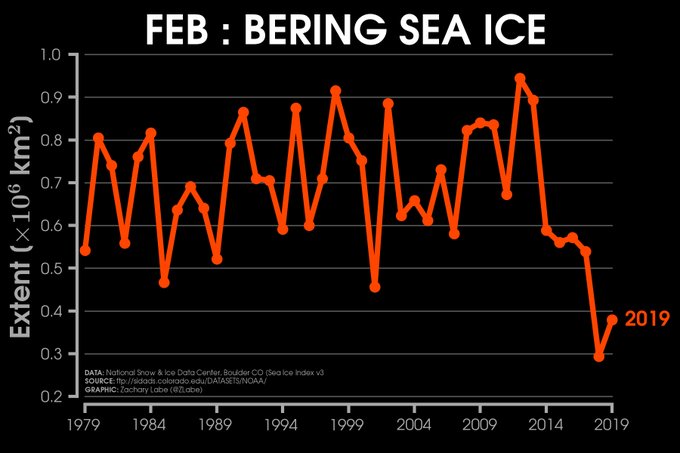
Sea ice extent in the Bering Sea was the 2nd lowest on record in February 2019 (after last year). This isn't some obscure statistic. This has significant impacts to Alaskan communities and ecosystems.
"The annual mean Arctic sea-ice extent decreased over the period 1979 to 2012, with a rate that was very likely in the range 3.5 to 4.1% per decade. Arctic sea-iceextent has decreased in every season and in every successive decade since 1979, with the most rapid decrease in decadal mean extent in summer (high confidence). It is very likely that the annual mean Antarctic sea-ice extent increased in the range of 1.2 to 1.8% per decade between 1979 and 2012.
"Arctic temperatures are rising faster than the global average. The Arctic was warmer from 2011 to 2015 than at any time since instrumental records began in around 1900, and has been warming more than twice as rapidly as the world as a whole for the past 50 years. January 2016 in the Arctic was 5°C warmer than the 1981–2010 average for the region, a full 2°C higher than the previous record set in 2008, and monthly mean temperatures in October through December 2016 were 6°C higher than average for these months. Sea temperatures are also increasing, both near the surface and in deeper water"
DEBUNKING "THE MOVIE WAS BANNED IN ENGLAND AND HAD 9 ERRORS MYTH":
UK High Court judge rejected a call to restrict the showing of Al Gore’s An Inconvenient Truth (AIT) in British schools.
The judge, Justice Burton found that “Al Gore’s presentation of the causes and likely effects of climate change in the film was broadly accurate”(which accords with our original assessment). There has been a lot of comment and controversy over this decision because of the judges commentary on 9 alleged “errors” (note the quotation marks!) in the movie’s description of the science. The judge referred to these as ‘errors’ in quotations precisely to emphasize that, while these were points that could be contested, it was not clear that they were actually errors.
There are a number of points to be brought out here. First of all, “An Inconvenient Truth” was a movie and people expecting the same depth from a movie as from a scientific paper are setting an impossible standard. Secondly, the judge’s characterisation of the 9 points is substantially flawed. He appears to have put words in Gore’s mouth that would indeed have been wrong had they been said (but they weren’t). Finally, the judge was really ruling on how “Guidance Notes” for teachers should be provided to allow for more in depth discussion of these points in the classroom.
Ice-sheet driven sea level rise Gore correctly asserted that melting of Greenland or the West Antarctic ice sheet would raise sea levels 20ft (6 meters). In the movie, no timescale for that was specified, but lest you think that the 20 ft number is simply plucked out of thin air, you should note that this is about how much higher sea level was around 125,000 years ago during the last inter-glacial period. Then, global temperatures were only a degree or two warmer than today – and given that this is close to the minimum temperature rise we can expect in the future, that 20 ft is particularly relevant. The rate at which this is likely to happen is however highly uncertain as we have discussedpreviously.
Pacific island nations needing to evacuate Much of Tuvalu is only a few feet above sea level, and any sea level rise is going to impact them strongly. The impacts are felt in seemingly disconnected ways – increasing brine in groundwater, increasing damage and coastal erosion from tides and storm surges, but they are no less real for that. The government of Tuvalu has asked New Zealand to be ready to evacuate islanders if needed, and while currently only 75 people per year can potentially be resettled, this could change if the situation worsened. In the movie there is only one line that referred to this: “That’s why the citizens of these pacific nations have all had to evacuate to New Zealand”, which is out of context in the passage it’s in, but could be said to only be a little ahead of it’s time.
Climate impacts on the ocean conveyor The movie references the Younger Dryas event that occurred 11,000 years ago when, it is thought, a large discharge of fresh water into the North Atlantic disrupted the currents, causing significant regional cooling. That exact scenario can’t happen again, but similar processes are likely to occur. The primary unresolved scientific issue regards how quickly the circulation is likely to change as we move forward. The model simulations in the latest IPCC report show a slowdown in the circulation – by about 30% by 2100 – but there is much we don’t understand about modeling that circulation and future inputs of freshwater from the ice sheets, so few are willing to completely rule out the possibility of a more substantial change in the future. Further discussion on what this really means and doesn’t mean is available here and here.
CO2 and Temperature connections in the ice core record Gore stated that the greenhouse gas levels and temperature changes over ice age signals had a complex relationship but that they ‘fit’. Again, both of these statements are true. The complexity though is actually quite fascinating and warrants being further discussed by those interested in how the carbon cycle will react in the future. We’ve discussed the lead/lag issue previously. A full understanding of why CO2 changes in precisely the pattern that it does during ice ages is elusive, but among the most plausible explanations is that increased received solar radiation in the southern hemisphere due to changes in Earth’s orbital geometry warms the southern ocean, releasing CO2 into the atmosphere, which then leads to further warming through an enhanced greenhouse effect. Gore’s terse explanation of course does not mention such complexities, but the crux of his point–that the observed long-term relationship between CO2 and temperature in Antarctica supports our understanding of the warming impact of increased CO2 concentrations–is correct. Moreover, our knowledge of why CO2 is changing now (fossil fuel burning) is solid. We also know that CO2 is a greenhouse gas, and that the carbon cycle feedback is positive (increasing temperatures lead to increasing CO2 and CH4), implying that future changes in CO2 will be larger than we might anticipate.
Kilimanjaro Gore is on even more solid ground with Kilimanjaro. In the movie, the retreat of Kilimanjaro is not claimed to be purely due to global warming , but it is a legitimate example of the sort of thing one expects in a warmer world, and is consistent with what almost all other tropical mountain glaciers are doing. There is indeed some ongoing discussion in the literature as to whether or not the retreat of ice on Kilimanjaro is related to the direct effects (warming atmospheric temperatures) or indirect effects (altered patterns of humidity, cloud cover, and precipitation influencing Kilimanjaro’s ice mass) of climate change, and that argument isn’t yet over. But these arguments would be of more relevance if (a) we were not witnessing the imminent demise of an ice field that we know has existed for at least the past 12,000 years and (b) most of the other glaciers weren’t disappearing as well.
Drying up of Lake Chad It is undisputed that Lake Chad has indeed shrunk rapidly in recent decades. While irrigation and upstream water use are probably contributing factors, the dominant cause is the reduction of rainfall across the entire Sahel from the 1950s to the 1980s and with rainfall today still substantially below the high point 50 years ago. There is substantial evidence that at least a portion of this drying out is human-caused. A few recent papers (Held et al, PNAS; Chung and Ramanathan and Biasutti and Giannini) have addressed causes ranging from Indian Ocean changes in sea surface temperature to the increase in atmospheric aerosols in the Northern hemisphere. Gore uses this example to illustrate that there are droughts in some regions even while other areas are flooding. Unfortunately this is exactly what the models suggest will happen.
Hurricane Katrina and global warming Katrina is used in the film as a legitimate illustration of the destructive power of hurricanes, our inability to cope with natural disaster, and the kind of thing that could well get worse in a warmer world. Nowhere does Gore state that Katrina was caused by global warming. We discussed this attribution issue back in 2005, and what we said then still holds. Individual hurricanes cannot be attributed to global warming, but the statistics of hurricanes, in particular the maximum intensities attained by storms, may indeed be.
Impact of sea ice retreat on Polar bears As we presaged in August, summer Arctic sea ice shattered all records this year for the minimum extent. This was partially related to wind patterns favorable to ice export in the spring, but the long term trends are almost certainly related to the ongoing and dramatic warming in the Arctic. Polar bears do indeed depend on the sea ice to hunt for seals in the spring and summer, and so a disappearance of this ice is likely to impact them severely. The specific anecdote referred to in the movie came from observations of anomalous drownings of bears in 2004 and so was accurate. However, studying the regional populations of polar bears is not easy and assessing their prospects is tough. In the best observed populations such as in western Hudson Bay (Stirling and Parkinson, 2006), female polar bear weight is going down as the sea ice retreats over the last 25 years, and the FWS is considering an endangered species listing. However, it should be stated that in most of the discussions about polar bears, they are used as a representative species. Arctic ecosystems are changing on many different levels, but it is unsurprising that charismatic mega-fauna get more press than bivalves. In the end, it may be the smaller and less photogenic elements that have the biggest impact.
Impact of ocean warming on coral reefs Corals are under stress from a multitude of factors; overfishing, deliberate destruction, water pollution, sea level rise, ocean acidification and, finally, warming oceans. The comment in the movie that rising temperatures and other factors cause coral bleaching is undoubtedly true. Bleaching episodes happen when the coral is under stress, and many examples have been linked to anomalously warm ocean temperatures (Australia in 1998 and 2002, all over the Indian Ocean in recent years). Corals are a sobering example of how climate change exacerbates existing vulnerabilities in eco-systems, potentially playing the role of the straw that breaks the camel’s back in many instances.
Overall, our verdict is that the 9 points are not “errors” at all (with possibly one unwise choice of tense on the island evacuation point). But behind each of these issues lies some fascinating, and in some cases worrying, scientific findings and we can only applaud the prospect that more classroom discussions of these subjects may occur because of this court case.
ANd:
Lambert goes on to look closely at the nine contended points. His conclusion:
Overall, there are a couple of points where I wish Gore would have talked about timescales and probabilities (sea level rise and thermohaline circulation), and a couple of examples that could have been better chosen (Kilimanjaro and Lake Chad). Burton was mistaken on the other points where he felt that Gore went past the consensus. I don’t think that there is any harm in the Guidance Notes on Burton’s nine points, but the usual suspects will, of course, ignore the fact that the judge found that Gore was “broadly accurate” and try to make it look as if there are serious problems with AIT and climate science.
Out of this — a judge rejects the suit, but finds nine points in the film he thinks differ slightly from the consensus, and it turns out he’s wrong about several and the others were at best matters of interpretation, omission, or insufficient context — the mainstream media pulled, in the words of an AP headline I saw earlier this evening, “Judge Says Gore Movie Not Scientific” (it has since been changed).