Temperatures To Decrease 0.5°C-0.7°C Due To Low Sunspots, Solar Minimum

Image Source: Abdussamatov, 2012
Funny how AGW is a "leftist communist hoax" all the time, but as soon as some russian no one has ever heard of says something which suit their narrative, the communist thing is forgotten..strange....anyway..here is the Zharkova nonsense debunked:
A Russian scientist named Zharkova who doesn't understand the science she's studying is simply making stuff up for sensationalist headlines. Some of the fault lies with Zharkova, who made comments ‘skeptical’ of human-caused global warming that were not supported by her research.
www.skepticalscience.com/mini-ice-age-myth-still-wrong.html
www.skepticalscience.com/no-sun-isnt-going-to-save-us-from-global-warming.html
www.realclimate.org/index.php/archives/2011/06/what-if-the-sun-went-into-a-new-grand-minimum/comment-page-1/#comment-208812
The weakening sun was not the determinant factor for the Little Ice Age. Strong volcanic eruptions in particular, but also a smaller amount of greenhouse gases in the atmosphere were important factors during this period of cooler climate in the 16th and 17th century, a new study shows.www.skepticalscience.com/no-sun-isnt-going-to-save-us-from-global-warming.html
www.realclimate.org/index.php/archives/2011/06/what-if-the-sun-went-into-a-new-grand-minimum/comment-page-1/#comment-208812
The paper presents a model for the sun's magnetic field and sunspots, which predicts a 60% fall in sunspot numbers when extrapolated to the 2030s. Crucially, the paper makes no mention of climate.
The first failure of science communication is present in the Royal Astronomical Society press release from July 9. It says that "solar activity will fall by 60 per cent during the 2030s" without clarifying that this "solar activity" refers to a fall in the number of sunspots, not a dramatic fall in the life-sustaining light emitted by the sun.
The press release also omits crucial details. It does say that the drop in sunspots may resemble the Maunder minimum, a 17th century lull in solar activity, and includes a link to the Wikipedia article on the subject. The press release also notes that the Maunder minimum coincided with a mini ice age.
But that mini ice age began before the Maunder minimum and may have had multiple causes, including volcanism.
Crucially, the press release doesn't say what the implications of a future Maunder minimum are for climate.
To be blunt: no mini ice age for us. The real story of the impending mini ice age isn't about climate at all. It is a cautionary tale, of how science should and shouldn't be communicated.
https://phys.org/news/2015-07-mini-ice-age-hoopla-giant.html
https://phys.org/news/2015-07-mini-ice-age-hoopla-giant.html
https://www.carbonbrief.org/why-the-sun-is-not-responsible-for-recent-climate-change?utm_source=Twitter&utm_medium=social&utm_campaign=EndHits18
Mange amatørfornektere vil jo og ha oss til å tro at dagens oppvarming kommer av at vi er på vei ut av, ikke le, Den Lille Istid. Study on the Little Ice Age: Low solar activity just marginally cools the climate.
Scientists have researched this very subject. What they've found is that the next ice age has been postponed indefinitely.
Per Tzedakis et al 2012,
"glacial inception would require CO2 concentrations below preindustrial levels of 280 ppmv"
For reference, we are at about 400 right now and climbing, so we can be relatively sure the next glacial epoch won't be happening in our lifetimes.
But what about further down the road? What happens then? Per Dr Toby Tyrrell (Tyrrell 2007) of the University of Southampton's School of Ocean and Earth Science at the National Oceanography Centre, Southampton:
"Our research shows why atmospheric CO2 will not return to pre-industrial levels after we stop burning fossil fuels. It shows that it if we use up all known fossil fuels it doesn't matter at what rate we burn them.
The result would be the same if we burned them at present rates or at more moderate rates; we would still get the same eventual ice-age-prevention result."
and
"Burning all recoverable fossil fuels could lead to avoidance of the next five ice ages."
Per Ganopolski et al 2016,
"even in the absence of human perturbations no substantial build-up of ice sheets would occur within the next several thousand years and that the current interglacial would probably last for another 50,000 years. However, moderate anthropogenic cumulative CO2 emissions of 1,000 to 1,500 gigatonnes of carbon will postpone the next glacial inception by at least 100,000 years....under natural conditions alone the Earth system would be expected to remain in the present delicately balanced interglacial climate state, steering clear of both large-scale glaciation of the Northern Hemisphere and its complete deglaciation, for an unusually long time"
http://advances.sciencemag.org/content/2/11/e1501923
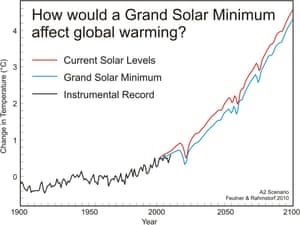
Feulner and Rahmstorf (2010) examined the impact on global warming if the sun fell into a Grand Solar Minimum. The global mean temperature difference is shown for the time period 1900 to 2100 for the IPCC A2 emissions scenario (relative to zero for the average temperature during the years 1961 to 1990). The red line shows predicted temperature change for the current level of solar activity, the blue line shows predicted temperature change for solar activity at the much lower level of the Maunder Minimum, and the black line shows observed temperatures from the NASA GISS dataset through 2010. The authors found that the average global surface temperature would be diminished by no more than 0.3°C due to the lower solar activity, which would offset only a small fraction of human-caused global warming.
Feulner and Rahmstorf (2010) examined the impact on global warming if the sun fell into a Grand Solar Minimum. The global mean temperature difference is shown for the time period 1900 to 2100 for the IPCC A2 emissions scenario (relative to zero for the average temperature during the years 1961 to 1990). The red line shows predicted temperature change for the current level of solar activity, the blue line shows predicted temperature change for solar activity at the much lower level of the Maunder Minimum, and the black line shows observed temperatures from the NASA GISS dataset through 2010. The authors found that the average global surface temperature would be diminished by no more than 0.3°C due to the lower solar activity, which would offset only a small fraction of human-caused global warming.
Impact of Volcanic Eruptions on Decadal to Centennial Fluctuations of Arctic Sea Ice Extent during the Last Millennium and on Initiation of the Little Ice Age
https://journals.ametsoc.org/doi/abs/10.1175/JCLI-D-16-0498.1
Global Signatures and Dynamical Origins of the Little Ice Age and Medieval Climate Anomaly
Abstract
Abstract
Global temperatures are known to have varied over the past 1500 years, but the spatial patterns have remained poorly defined. We used a global climate proxy network to reconstruct surface temperature patterns over this interval. The Medieval period is found to display warmth that matches or exceeds that of the past decade in some regions, but which falls well below recent levels globally. This period is marked by a tendency for La Niña–like conditions in the tropical Pacific. The coldest temperatures of the Little Ice Age are observed over the interval 1400 to 1700 C.E., with greatest cooling over the extratropical Northern Hemisphere continents. The patterns of temperature change imply dynamical responses of climate to natural radiative forcing changes involving El Niño and the North Atlantic Oscillation–Arctic Oscillation.
Abrupt onset of the Little Ice Age triggered by volcanism and sustained by sea‐ice/ocean feedbacks
https://agupubs.onlinelibrary.wiley.com/doi/full/10.1029/2011GL050168
This implies that low solar activity, which is expected by some researchers for the coming decades, cannot considerably slow down global warming caused by humankind’s greenhouse gas emissions.
“The impact of variations in solar activity on the climate is often overestimated,” says Georg Feulner of the Potsdam Institute for Climate Impact Research (PIK). He is the author of the article just published in Geophysical Research Letters. “This is what our new analysis shows for the past – and we can learn from this to understand future climate change.”
The main drivers of the Little Ice Age cooling were decreased solar activity and increased volcanic activity. These factors cannot account for the global warming observed over the past 50-100 years. Furthermore, it is physically incorrect to state that the planet is simply "recovering" from the Little Ice Age.
Research has suggested that the solar minimum around the year 1650 played a relatively small role in the cool temperatures during the Little Ice Age. Instead, heightened volcanic activity (pumping ash into the atmosphere that blocks sunlight) and a drop in atmospheric carbon levels were the main contributors to the cooling during that time. Third, the Little Ice Age wasn’t even that cold, globally. The following chart shows the most comprehensive global surface temperature reconstruction to date, from the PAGES 2k Consortium. In just the past few decades the planet has warmed more than it cooled during the entire Little Ice Age.

http://www.pik-potsdam.de/~stefan/Publications/Journals/feulner_rahmstorf_2010.pdf
This ‘impending mini ice age’ myth is incredibly easy to debunk. In fact it just takes asking one simple question – if the sun is such a key driver of the Earth’s climate, then why has the entire planet (air, oceans, land, and ice) warmed rapidly over the past 60 years while solar activity has declined?
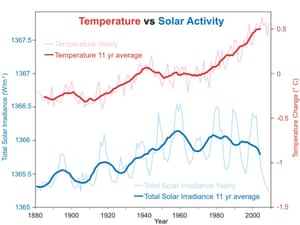
Annual global temperature change (thin light red) with 11 year moving average of temperature (thick dark red). Temperature from NASA GISS. Annual Total Solar Irradiance (thin light blue) with 11 year moving average of TSI (thick dark blue). TSI from 1880 to 1978 from Krivova et al 2007 (data). TSI from 1979 to 2009 from PMOD.
The reduced energy from the Sun sets into motion a sequence of events on Earth beginning with a thinning of the stratospheric ozone layer. That thinning in turn changes the temperature structure of the stratosphere, which then changes the dynamics of the lower atmosphere, especially wind and weather patterns. The cooling is not uniform. While areas of Europe chilled during the Maunder Minimum, other areas such as Alaska and southern Greenland warmed correspondingly.
https://www.sciencedaily.com/releases/2018/02/180206105858.htm
Peer-reviewed research, physics, and math all tell us that a grand solar minimum would have no more than a 0.3°C cooling effect, barely enough to put a dent in human-caused global warming.
Research has suggested that the solar minimum around the year 1650 played a relatively small role in the cool temperatures during the Little Ice Age. Instead, heightened volcanic activity (pumping ash into the atmosphere that blocks sunlight) and a drop in atmospheric carbon levels were the main contributors to the cooling during that time. Third, the Little Ice Age wasn’t even that cold, globally. The following chart shows the most comprehensive global surface temperature reconstruction to date, from the PAGES 2k Consortium. In just the past few decades the planet has warmed more than it cooled during the entire Little Ice Age.
To sum up, a number of scientific studies have asked the question, ‘if the sun were to enter another extended quiet phase (a grand solar minimum), how would that impact global surface temperatures?’. Every study agrees, it would cause no more than 0.3°C cooling, which would only be enough to temporarily offset about a decade’s worth of human-caused global warming.
http://www.pik-potsdam.de/~stefan/Publications/Journals/feulner_rahmstorf_2010.pdf
This ‘impending mini ice age’ myth is incredibly easy to debunk. In fact it just takes asking one simple question – if the sun is such a key driver of the Earth’s climate, then why has the entire planet (air, oceans, land, and ice) warmed rapidly over the past 60 years while solar activity has declined?
Annual global temperature change (thin light red) with 11 year moving average of temperature (thick dark red). Temperature from NASA GISS. Annual Total Solar Irradiance (thin light blue) with 11 year moving average of TSI (thick dark blue). TSI from 1880 to 1978 from Krivova et al 2007 (data). TSI from 1979 to 2009 from PMOD.
The reduced energy from the Sun sets into motion a sequence of events on Earth beginning with a thinning of the stratospheric ozone layer. That thinning in turn changes the temperature structure of the stratosphere, which then changes the dynamics of the lower atmosphere, especially wind and weather patterns. The cooling is not uniform. While areas of Europe chilled during the Maunder Minimum, other areas such as Alaska and southern Greenland warmed correspondingly.
Despite how much the Maunder Minimum might have affected Earth the last time, Lubin said that an upcoming event would not stop the current trend of planetary warming but might slow it somewhat. The cooling effect of a grand minimum is only a fraction of the warming effect caused by the increasing concentration of carbon dioxide in the atmosphere. After hundreds of thousands of years of CO2 levels never exceeding 300 parts per million in air, the concentration of the greenhouse gas is now over 400 parts per million, continuing a rise that began with the Industrial Revolution. Other researchers have used computer models to estimate what an event similar to a Maunder Minimum, if it were to occur in coming decades, might mean for our current climate, which is now rapidly warming.
One such study looked at the climate consequences of a future Maunder Minimum-type grand solar minimum, assuming a total solar irradiance reduced by 0.25 percent over a 50-year period from 2020 to 2070. The study found that after the initial decrease of solar radiation in 2020, globally averaged surface air temperature cooled by up to several tenths of a degree Celsius. By the end of the simulated grand solar minimum, however, the warming in the model with the simulated Maunder Minimum had nearly caught up to the reference simulation. Thus, a main conclusion of the study is that "a future grand solar minimum could slow down but not stop global warming."
Peer-reviewed research, physics, and math all tell us that a grand solar minimum would have no more than a 0.3°C cooling effect, barely enough to put a dent in human-caused global warming.

The idea of a Grand Solar Minimum (GSM) causing weather extremes, specifically cooling on parts of our planet today is deeply flawed (just wrong) and has no basis in reality. I clearly explain here how variability in sunspots cause tiny changes in solar output (0.5/1361 or 1 part in 2722), and changes in climate impact of about 0.05 in 2.7 which is eeny-weeny-teeny compared to greenhouse gas impacts. Also, solar cycles, reflected in sunspot counts, are on an 11 year timescale, which clearly cannot explain the abrupt climate change occurring.
Impact of a potential 21st century “grand solar minimum” on surface temperatures and stratospheric ozone
https://agupubs.onlinelibrary.wiley.com/doi/full/10.1002/grl.50806
So no ice ages and no Arctic sea ice recovery the next million years...
https://academic.oup.com/plankt/article/30/2/141/1435509
doi: 10.1093/plankt/fbm105
Tzedakis et al 2012 - Determining the natural length of the current interglacial
https://www.nature.com/articles/ngeo1358
doi:10.1038/ngeo1358
https://www.nature.com/articles/ngeo1358
doi:10.1038/ngeo1358
Ganopolski et al 2016 - Critical insolation–CO2 relation for diagnosing past and future glacial inception
doi:10.1038/nature16494
Bonus:
Regional climate impacts of a possible future grand solar minimum
Any reduction in global mean near-surface temperature due to a future decline in solar activity is likely to be a small fraction of projected anthropogenic warming. However, variability in ultraviolet solar irradiance is linked to modulation of the Arctic and North Atlantic Oscillations, suggesting the potential for larger regional surface climate effects. Here, we explore possible impacts through two experiments designed to bracket uncertainty in ultraviolet irradiance in a scenario in which future solar activity decreases to Maunder Minimum-like conditions by 2050. Both experiments show regional structure in the wintertime response, resembling the North Atlantic Oscillation, with enhanced relative cooling over northern Eurasia and the eastern United States. For a high-end decline in solar ultraviolet irradiance, the impact on winter northern European surface temperatures over the late twenty-first century could be a significant fraction of the difference in climate change between plausible AR5 scenarios of greenhouse gas concentrations. https://www.nature.com/articles/ncomms8535
Bonus:
Regional climate impacts of a possible future grand solar minimum
Any reduction in global mean near-surface temperature due to a future decline in solar activity is likely to be a small fraction of projected anthropogenic warming. However, variability in ultraviolet solar irradiance is linked to modulation of the Arctic and North Atlantic Oscillations, suggesting the potential for larger regional surface climate effects. Here, we explore possible impacts through two experiments designed to bracket uncertainty in ultraviolet irradiance in a scenario in which future solar activity decreases to Maunder Minimum-like conditions by 2050. Both experiments show regional structure in the wintertime response, resembling the North Atlantic Oscillation, with enhanced relative cooling over northern Eurasia and the eastern United States. For a high-end decline in solar ultraviolet irradiance, the impact on winter northern European surface temperatures over the late twenty-first century could be a significant fraction of the difference in climate change between plausible AR5 scenarios of greenhouse gas concentrations. https://www.nature.com/articles/ncomms8535
http://onlinelibrary.wiley.com/doi/10.1029/2011GL048529/full
_______________________________________________
"this "solar activity" refers to a fall in the number of sunspots, not a dramatic fall in the life-sustaining light emitted by the sun."
And
And to complete the debunking:
"In plain English, the small change in sunlight reaching the Earth during a new Maunder minimum wouldn't be enough to reverse climate change. For the technically minded, even a 3 W per m2 change in irradiance corresponds to a radiative forcing of just 0.5 W per m2 (because the Earth is a sphere and not a flat circle), which is less than the radiative forcing produced by anthropogenic greenhouse gases.
_______________________________________________
Further:
"Those hoping that the sun could save us from climate change look set for disappointment. The recent lapse in solar activity is not the beginning of a decades-long absence of sunspots – a dip that might have cooled the climate. Instead, it represents a shorter, less pronounced downturn that happens every century or so."
"According to the Gleissberg cycle, the next solar maximum – in about 2024 – will probably be a dud too, but then cycles will become more energetic once again, and any cooling effect the brief downturn has had on Earth's climate will also vanish."
www.newscientist.com/article/dn23865-suns-quiet-spell-not-the-start-of-a-mini-ice-age.html#.UeF_4mS9Kc1
Even if the sun got stuck in a permanent Maunder Minimum, the warming from our CO2 emissions will still warm our planet and continue to change our climate:
"Thus if the sun remains “out”, i.e., stuck for a long period in the current solar minimum, it can offset only about 7 years of CO2 increase. The human-made greenhouse gas climate forcing is now relentlessly, monotonically, increasing at a rate that overwhelms variability of natural climate forcings. Unforced variability of global temperature is great, as shown in Figure 4, but the global temperature trend on decadal and longer time scales is now determined by the larger human-made climate forcing. Speculation that we may have entered a solar-driven long-term cooling trend must be dismissed as a pipe-dream."
bravenewclimate.com/2008/09/14/what-if-the-sun-got-stuck/
www.newscientist.com/article/dn23865-suns-quiet-spell-not-the-start-of-a-mini-ice-age.html#.UeF_4mS9Kc1
Even if the sun got stuck in a permanent Maunder Minimum, the warming from our CO2 emissions will still warm our planet and continue to change our climate:
"Thus if the sun remains “out”, i.e., stuck for a long period in the current solar minimum, it can offset only about 7 years of CO2 increase. The human-made greenhouse gas climate forcing is now relentlessly, monotonically, increasing at a rate that overwhelms variability of natural climate forcings. Unforced variability of global temperature is great, as shown in Figure 4, but the global temperature trend on decadal and longer time scales is now determined by the larger human-made climate forcing. Speculation that we may have entered a solar-driven long-term cooling trend must be dismissed as a pipe-dream."
bravenewclimate.com/2008/09/14/what-if-the-sun-got-stuck/
"this "solar activity" refers to a fall in the number of sunspots, not a dramatic fall in the life-sustaining light emitted by the sun."
And
"As discussed previously, the impact of a new Maunder minimum on climate has been studied many times. There's 40% more CO2 in the air now than during the 17th century, and global temperature records are being smashed. A new Maunder minimum would slow climate change, but it is not enough to stop it."
And to complete the debunking:
"In plain English, the small change in sunlight reaching the Earth during a new Maunder minimum wouldn't be enough to reverse climate change. For the technically minded, even a 3 W per m2 change in irradiance corresponds to a radiative forcing of just 0.5 W per m2 (because the Earth is a sphere and not a flat circle), which is less than the radiative forcing produced by anthropogenic greenhouse gases.
The analysis techniques used to underpin the prediction of very low sunspot numbers (principal component analysis) is well known and ‘valid’ as to what it does. Using it to project into the future is somewhat less valid, as other factors which have not shown up in the past data may be waiting in the wings. I guess I would rate the chances of very low sunspot numbers in the 2030s as less than 50-50, but certainly not at, or close to, zero.
So that brings us to the more important issue of the impacts. The Little Ice Age (so-called) is certainly ‘real’, although many questions remain. When did it begin? I’ve seen dates of anywhere from 1300 to 1450 – both well before the start of the Maunder Minimum in 1645.
When did it end? Again I’ve seen dates as late as 1850 (well after the end of the MM in 1715), which might well imply that the only reason it did end is the onset of global warming!
Was it global, or regional? There is plenty of evidence from Europe and some from North America. I’ve seen a suggestion of some evidence from New Zealand. However there do seem to be many questions around the uniformity of the cooling.
So that brings us to the really key question of the causes/drivers. Solar activity is certainly one possibility, although as I’ve indicated the MM certainly couldn’t have started it. It may have made things just a little bit cooler – say 0.2 C – but it wasn’t the cause! Other suggestions have been a slowing of the Gulf Stream (it has slowed significantly in the past. ~11,000 years ago); volcanic activity (a couple of major eruptions followed by some feedbacks); and ‘orbital forcing’. We know that changes in the Earth’s orbit are the drivers of the glacial-interglacial cycle (something one of the authors of the paper in question is clearly ignorant of!), and these drivers don’t stop and start, but are on-going. We probably are heading ever so slowly for the next glacial.
Like most scientists who have made ‘meaningful’ comments, my view is that, if it does happen, it will reduce global warming by ~0.1 C – or delay it by ~10 years. And that delay would only be temporary, and temperature would zoom ahead in the years that followed.
https://krohde.wordpress.com/2016/02/27/misleading-information-on-climate-change-and-corrections/
So that brings us to the more important issue of the impacts. The Little Ice Age (so-called) is certainly ‘real’, although many questions remain. When did it begin? I’ve seen dates of anywhere from 1300 to 1450 – both well before the start of the Maunder Minimum in 1645.
When did it end? Again I’ve seen dates as late as 1850 (well after the end of the MM in 1715), which might well imply that the only reason it did end is the onset of global warming!
Was it global, or regional? There is plenty of evidence from Europe and some from North America. I’ve seen a suggestion of some evidence from New Zealand. However there do seem to be many questions around the uniformity of the cooling.
So that brings us to the really key question of the causes/drivers. Solar activity is certainly one possibility, although as I’ve indicated the MM certainly couldn’t have started it. It may have made things just a little bit cooler – say 0.2 C – but it wasn’t the cause! Other suggestions have been a slowing of the Gulf Stream (it has slowed significantly in the past. ~11,000 years ago); volcanic activity (a couple of major eruptions followed by some feedbacks); and ‘orbital forcing’. We know that changes in the Earth’s orbit are the drivers of the glacial-interglacial cycle (something one of the authors of the paper in question is clearly ignorant of!), and these drivers don’t stop and start, but are on-going. We probably are heading ever so slowly for the next glacial.
Like most scientists who have made ‘meaningful’ comments, my view is that, if it does happen, it will reduce global warming by ~0.1 C – or delay it by ~10 years. And that delay would only be temporary, and temperature would zoom ahead in the years that followed.
https://krohde.wordpress.com/2016/02/27/misleading-information-on-climate-change-and-corrections/
Ingen kommentarer:
Legg inn en kommentar